

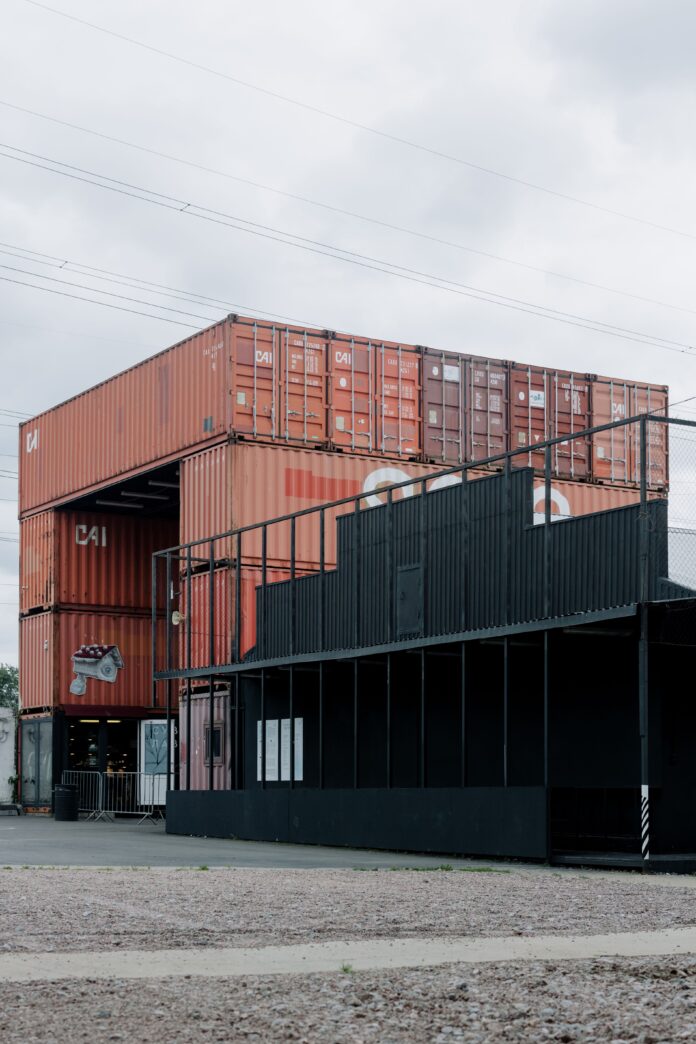
A standard shipping container has a ceiling, four walls, and a door that has to close. That sounds obvious until you’re standing next to a turbine housing that’s two feet taller than the container’s own interior. At that point the conversation with the shipper changes completely. Nobody’s arguing about price per mile anymore. They’re arguing about whether the load fits through a tunnel in Ohio.
Most people who’ve never worked in logistics assume “big” and “heavy” are basically the same problem. They’re not. A load can be light and still too wide for a container door. A load can fit inside a box and still be too heavy for the axles underneath it. Oversized freight breaks the rules in different ways, and each way calls for a different fix.
Why the box stops working
Containers are built around a handful of fixed dimensions that the entire global shipping system agrees on. That agreement is exactly what makes them efficient — cranes, ships, rail cars, and trucks all assume the same box shape, so nobody has to redesign anything at each stop. The moment cargo doesn’t respect those dimensions, that whole efficiency collapses.
Refinery vessels are a good example of how this plays out. A distillation column can arrive from the fabricator as one welded piece, and cutting it apart just to fit shipping rules would defeat the entire purpose of building it that way. Mining crushers run into the same wall — a single jaw crusher housing can weigh more than a loaded container ship’s crane is rated to lift casually. Prefabricated bridge sections, generator skids, and transformer tanks all land in the same category. None of them were designed with a container door in mind. They were designed to do a job, and the shipment gets built around that job instead of the other way around.
What actually carries it
This is where flatbed equipment comes in, and it comes in more forms than people expect. A standard flatbed handles freight that’s simply too tall or too wide for an enclosed trailer but still within normal weight limits. Step-deck trailers drop the deck height to buy extra vertical clearance for taller loads. Removable-gooseneck trailers let cargo be driven or rolled directly onto the deck instead of craned into place, which matters enormously for anything that can’t be lifted safely by its own structure.
Then there’s the heavier end of the spectrum. Multi-axle trailers spread weight across enough wheels that a single road segment isn’t asked to bear more than it’s rated for. Some heavy-haul jobs use hydraulic modular trailers that can be configured almost like building blocks, adding axle lines until the weight-per-axle number finally falls inside a legal range. None of this is exotic engineering. It’s mostly arithmetic, applied carefully.
| Equipment type | Typical cargo | Best suited for | Typical constraint solved |
| Standard flatbed | Steel coils, pipe racks, crated machinery | Wide or tall loads at normal weight | Container clearance limits |
| Step-deck trailer | Tractors, generators, tall crated units | Tall equipment, machinery | Overhead bridge and tunnel height |
| Removable-gooseneck (RGN) | Excavators, transformers, industrial presses | Loads that can’t be craned | Loading and unloading access |
| Multi-axle / modular trailer | Distillation columns, bridge girders, reactor vessels | Very heavy, dense cargo | Axle weight and bridge load limits |
The table only tells half the story, though. In practice, the choice between these usually comes down to a phone call between the carrier’s permitting team and whatever state or county controls the route, because the trailer is only half the equation.
The numbers behind that phone call are worth knowing. In many U.S. states, anything wider than 8 ft 6 in (2.59 m) already needs a special permit before it can touch a public road, and that threshold catches more loads than people expect. Height limits usually sit around 13 ft 6 in before overpasses become a genuine concern, and weight limits per axle group are what actually decide whether a bridge along the route can take the load at all. Once a shipment pushes past those numbers by any real margin, the process stops being a permit application and turns into a full route survey, with utility companies coordinated in advance and, on the largest moves, temporary road closures arranged block by block.
The part nobody thinks about until it’s a problem
Here’s something that surprises a lot of shippers the first time they deal with an oversized load: the truck is rarely the hard part. Routing is. A load that’s perfectly legal to drive can still get stuck behind a bridge rated for less weight than it’s carrying, or a power line strung too low over a rural road that was never meant for anything wider than a farm tractor.
That’s why heavy-haul routes get planned days or sometimes weeks ahead, with survey vehicles checking clearances block by block. Permits differ from state to state, and a route that works fine on paper in one jurisdiction can require an escort vehicle, a specific time window, or even a police lead car in another. Somebody has to know these rules cold, because a load that shows up at a low bridge with no detour planned isn’t just late. It’s stuck.
It also isn’t one person’s job to catch all of this. A shipper knows what the cargo is and where it needs to end up, but rarely knows which county requires a utility crew to lift a power line out of the way. That’s what the heavy-haul carrier is for, along with a permitting specialist who deals with state transportation departments for a living, a route engineer who actually drives or surveys the path in advance, and often a crane contractor who has to be scheduled to arrive at the destination at the exact hour the load does. Miss any one of those, and the rest of the plan doesn’t matter.
Escorts, timing, and the human factor
Pilot cars aren’t decoration. On a load wide enough to cross into oncoming lanes, a lead vehicle warns other drivers before they’re surprised by six feet of steel coming around a curve. Depending on the size, some states require escorts front and back, sometimes with height poles that physically test overhead clearance before the truck itself gets there.
Timing matters just as much. Plenty of oversized moves happen overnight specifically to avoid rush-hour traffic and reduce the number of other vehicles sharing the road with something that can’t stop quickly or swerve at all. A load that would take four hours during the day might roll through at 2 a.m. instead, past empty intersections, with far less room for anything to go wrong.
It isn’t always a truck for the whole trip
Road transport gets most of the attention, but plenty of oversized cargo never sees a highway for its full journey. A transformer built overseas might travel by ship to a port, get lowered onto a barge for the inland leg of the trip, then finally end up on a trailer for the last few miles to the substation. Rail cars handle some of this too, particularly for cargo that’s heavy but not unusually wide, since rail weight limits per axle tend to be more forgiving than road limits.
The handoffs between these modes are where things tend to go sideways. A crane has to lift the load from ship to barge, then again from barge to trailer, and each lift is its own risk with its own rigging plan. Coordinating all of that so nothing sits waiting at a dock for three extra days isn’t a small feat of scheduling, and it’s often the part of the job that takes longer to plan than the actual road route.
Why oversized cargo costs so much more
None of this comes cheap, and the price tag rarely comes from the trailer itself. Permits alone can take weeks to process across multiple states, and each one costs money regardless of whether the load ever gets held up. Escort vehicles are billed by the hour, route surveys need to be paid for whether or not they turn up a problem, and any bridge or overpass that needs temporary reinforcement adds engineering costs before the truck even leaves. Add in the crane time at both ends and the very real possibility of night moves to avoid traffic, and it’s easy to see why a shipment can cost more to move than the equipment sitting on the trailer is worth.
Why this rarely goes wrong at the last minute
The reason experienced carriers rarely get caught off guard isn’t luck. It’s that the planning happens long before the truck leaves the yard. Engineers calculate weight distribution before a single strap is tightened. Route surveys catch the low bridge before the driver does. Permits get filed for every county the load will pass through, sometimes months in advance for the largest projects.
None of that removes the risk entirely. Weather shifts, a bridge gets closed for repair, a permit takes longer than expected. What it does is turn a genuinely difficult logistical puzzle into something manageable, piece by piece, instead of a gamble made at the loading dock. That’s really the whole difference between oversized freight and everything else: nothing about it is routine, so nothing about the planning can afford to be either.