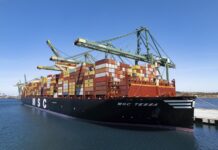

Mirror-image statistics from Beijing and Washington reveal permanent fracture in world’s most important trade relationship.
China’s announcement of a record USUS$1 trillion trade surplus masks a 29% plunge in shipments to America, while new data from the National Retail Federation reveals US container imports are headed for their steepest sustained decline in years confirming that the transpacific trade corridor is experiencing structural collapse, not temporary adjustment.
US ports handled 2.07 million Twenty-Foot Equivalent Units in October, down 7.9% year-over-year, according to the Global Port Tracker report from the NRF and Hackett Associates.
But the real shock lies ahead: November imports are projected to fall 11.6%, December by 12.7%, with double-digit declines extending through April 2026. December would mark the slowest month since June 2023, a dramatic reversal following July’s peak of 2.39 million TEU.
The convergence of Chinese export statistics and American import projections exposes a critical reality: what initially appeared as tactical maneuvering around tariffs has hardened into permanent trade pattern restructuring.
China’s ability to maintain overall export growth while losing nearly a third of its US market demonstrates successful diversification to the European Union, Latin America, and Africa.
Meanwhile, America’s import decline persists despite record holiday sales forecast to exceed US$1 trillion suggesting U.S. retailers have successfully shifted sourcing or built inventory cushions that reduce dependence on Chinese supply.
Many US retailers frontloaded cargo earlier in 2025 to beat expected tariffs, leaving store shelves well-stocked for the holiday season but creating what the NRF calls a “cargo vacuum” in subsequent months.
This frontloading exhaustion partially explains the fourth-quarter collapse, but projections extending through mid-2026 indicate something deeper than inventory timing.
Container rates on both US coasts are declining despite ongoing Red Sea disruptions that temporarily spiked freight costs earlier in 2025. The rate softening reflects reduced competition for transpacific capacity as trade volumes contract a capacity surplus developing on what was traditionally the world’s most profitable shipping route.
The trade policy landscape remains volatile. The Trump administration recently reduced tariffs on some food products, but broader tariffs imposed under the International Emergency Economic Powers Act face a Supreme Court challenge.
Yet even if tariffs are struck down, the administration is likely to seek reinstatement under alternative trade authorities, ensuring continued uncertainty.
Full-year 2025 US imports are now forecast at 25.2 million TEU, down 1.4% from 2024’s 25.5 million TEU a modest overall decline that masks the accelerating fourth-quarter collapse. The 2026 outlook presents continued challenges, with March imports projected to plummet 16.8% year-over-year, the steepest monthly decline in the forecast period.
What emerges is a new normal: bilateral trade flows fragmenting into parallel systems, with each side adapting to chronic instability rather than hoping for restoration of previous patterns.