

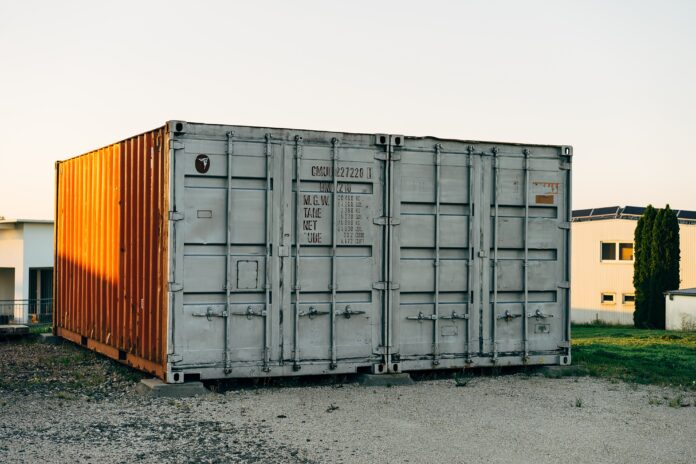
An import container that clears the terminal gate still has most of its journey and most of its cost ahead. The ocean leg prices out at pennies per cubic foot. The inland leg does not. Yet a large share of importers move freight inland in the same marine box it crossed the ocean in, paying full linehaul on equipment that was never designed for domestic economics. Container transloading—stripping the ocean box near the port and reloading the freight into domestic trailers—exists because that default stopped making financial sense. The math is worth walking through slowly, because most routing decisions never are.
The default nobody prices
When a box discharges, the path of least resistance is to keep freight in it. Rail it inland under an IPI move, or put it on a chassis and dray it the whole way. One less handling event, one less facility in the chain. That is the entire argument for it, and on paper it looks like prudence.
What the default actually does is extend marine equipment economics deep into a domestic supply chain. A marine container inland carries less freight per mile than the trailer running next to it, keeps an ocean carrier’s per diem clock running the entire trip, keeps a chassis on rent under it, and finishes its journey with an empty repositioning move that someone has to pay for. None of those line items appear in the routing decision. All of them appear on invoices later.
The cube math: three 40-foot boxes, two 53-foot trailers
The core numbers are fixed by the equipment itself.
A standard 40-foot container holds roughly 2,390 cubic feet. A 40-foot high cube holds about 2,700. A 53-foot dry van gives you roughly 3,900 to 4,000 usable cubic feet. On the floor, a 40-foot box takes about 20 standard 48-by-40 pallets in a single tier. A 53-foot trailer takes 26 straight loaded and up to 30 pinwheeled.
Run the consolidation: three 40-foot high cubes hold about 8,100 cubic feet of freight. Two 53-foot trailers hold about 8,000. For freight that cubes out before it weighs out, which describes most consumer goods, furniture, apparel, and e-commerce inventory, three inbound boxes reload into two outbound trailers with almost nothing left over.
That ratio is the whole argument in one line. With cube-driven freight, keeping the marine box means running three trucks when two would suffice. Transloading deletes roughly a third of the inland linehaul spend before anyone negotiates a rate.
Transloading vs cross-docking: what actually happens at the dock
The terms travel together and blur together, so it is worth being precise. Cross-docking is a flow pattern: freight moves from an inbound door to an outbound door with hours or a day of dwell, not weeks of storage. Transloading is an equipment change: freight is moved from a marine container to a domestic trailer or a railcar.
At an import gateway, the two are usually the same physical motion. A crew strips the box, sorts and restacks the freight, and reloads it onto domestic equipment across the dock, often with a short buffer in between. Rework rides along for next to nothing while the freight is already on the floor: carton relabeling, retail-ready prep, and breaking a mixed SKU load into store- or channel-level segregations. Shippers who transload purely for the cube savings tend to discover the rework capability is what they keep coming back for.
The cost stack: drayage, chassis days, and the per diem clock
The consolidation ratio is only half the case. The other half is what the marine container costs you every day it stays in your custody.
Ocean carriers grant a few free days after discharge, typically two to seven, depending on the contract. After free time expires, detention charges of roughly $ 100 to $ 250 per container per day are standard, and some San Pedro Bay terminals now start above $ 175 and escalate past $ 300. The chassis under the box bills its own meter at roughly $ 30 to $ 50 per day at most gateways. Send that box 1,200 miles inland, and every day of transit, unloading, dwell, and empty return runs both meters. The return leg itself is a paid move: an empty marine container at an inland destination has to dray back to a depot or ramp at domestic truck rates, hauling nothing.
A transload flips every one of those charges. The box moves one short-container drayage leg from the terminal to a nearby dock, is stripped the same day or the next, and returns within free time. Where the operator can match an import box to a nearby exporter’s booking, a street turn, the empty return leg disappears entirely, and the demurrage and detention exposure drops to zero. The freight, meanwhile, rides inland on domestic equipment with no per diem, no chassis meter,r and a third fewer trucks.
What a transload facility needs to actually deliver
The savings above assume the dock operation holds up its end, and this is where transload programs quietly succeed or fail. Evaluating a cross-docking warehouse near a gateway comes down to a short list.
Door count and same-day strip capacity matter first. Marine loads arrive floor-stacked, blocked, and braced, and a 2,700-cubic-foot box takes two to four labor hours to strip and restack. A facility without the doors and crew depth to turn your boxes inside free time is just relocating your detention bill. Domestic equipment access matters second: trailer pools and drop capability, so freight never waits on a live tractor. Rework capability third, if labeling or retail prep is in scope. Short-term buffer storage, fourth, because import surges never match outbound schedules exactly.
Geography decides the rest, because the dray is the one leg you cannot consolidate away. Importers working the southern end of the Southern California market, National City discharges, Otay Mesa crossings, or freight routed away from the San Pedro Bay queue, use cross-docking in San Diego to keep the container drayage leg short and put freight onto domestic trailers the same day it leaves the terminal. The principle generalizes to any gateway: the transload dock earns its keep in proportion to how fast it gets the box back and the freight moving.
When keeping the box wins
Transloading is not a universal answer, and the honest cases against it are worth naming.
Weight-out freight gains nothing. Dense product, tile, canned goods, machinery parts, hits the roughly44,000-poundd road limit long before it fills the cube, and a 53-foot trailer carries no more payload than the box did. The 3:2 ratio collapses to 1:1, and the transload is pure added cost.
Short inland moves rarely justify the touch. A single-consignee full box moving 150 miles to one dock should stay in the container. The handling event only pays for itself when there are linehaul miles or a consolidation gain to harvest.
Carrier haulage moves are already committed. Freight booked IPI under the ocean carrier’s through bill has its inland leg priced and controlled by the carrier, and intercepting it at the port is a contractual fight before it is an operational one.
Sealed, bonded, or high-fragility freight can carry a real cost per touch. When the integrity of the original load matters more than linehaul efficiency, the box stays shut.
Everything else, which is most cube-driven import freight moving real inland distances, is a candidate. Three boxes in, two trailers out, the empties home inside free time. Importers who run this math once tend not to revert to the default. The ones who never run it keep paying a third more per inland mile, without a line item stating so.