
The latest Readers Speak poll asked readers:
What is the biggest lesson from the Hormuz crisis?
The results revealed a divided but insightful response, highlighting how the crisis has reshaped industry thinking about risk, trade, and resilience.
Politics and trade are becoming inseparable
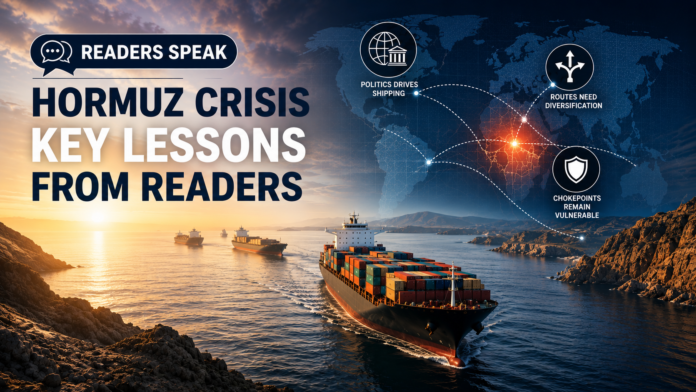
Two responses emerged as the strongest among readers: ”Politics drives shipping” and ”Routes need diversification”.
The strong support for these options reflects a growing recognition that global shipping is increasingly influenced by geopolitical developments. Diplomatic disputes, sanctions, military tensions, and state policies are now seen as factors that can directly affect vessel movements, trade flows, and supply chain planning.
For many readers, the Hormuz crisis demonstrated that shipping can no longer be viewed separately from the political environment in which it operates.
Diversification is now a strategic necessity
The equally strong support for route diversification suggests that resilience has become a central priority for the industry.
Repeated disruptions affecting major maritime corridors have reinforced the importance of flexibility in network design and supply chain planning. Rather than relying heavily on a limited number of strategic routes, many readers appear to believe that future resilience will depend on the ability to adapt quickly when disruptions occur.
The crisis has highlighted how vulnerable global trade can become when critical volumes are concentrated through a small number of chokepoints.
Chokepoints remain a fundamental vulnerability
A significant share of readers identified ”Chokepoints remain vulnerable” as the most important lesson.
The Strait of Hormuz crisis has once again demonstrated how events in a single waterway can influence shipping operations, freight markets, energy flows, and global supply chains.
Despite advances in technology, fleet management, and logistics planning, strategic maritime passages remain critical points of exposure for international trade. The results suggest that many readers continue to view chokepoint risk as one of the industry’s most persistent structural challenges.
Security costs are viewed as a consequence rather than the lesson
The least selected response was ”Security has a price”.
While higher insurance premiums, additional security measures, naval deployments, and operational costs have all become familiar features of the crisis, readers appear to see these impacts as symptoms rather than the core lesson.
The findings suggest that participants are more focused on the underlying drivers of disruption than on the costs that follow.
A shift toward long-term thinking
What makes these results particularly notable is that they move beyond immediate operational concerns.
Rather than focusing on individual incidents, readers identified broader strategic themes that are likely to influence shipping long after the current crisis subsides.
Whether through geopolitics, route diversification, or chokepoint vulnerability, the common message is that resilience is becoming a defining priority for the industry.
Conclusion
The Hormuz crisis has generated months of disruption, uncertainty, and debate across the maritime sector.
According to readers, its most important legacy is not a single event but a broader realization: politics, trade routes, and maritime security have become more closely connected than ever before.
While opinions differ on the primary lesson, the results point toward a common conclusion: the future of shipping will increasingly depend on adaptability, strategic planning, and the ability to navigate a more complex geopolitical environment.