

Uncertainty and restriction dominate industry sentiment
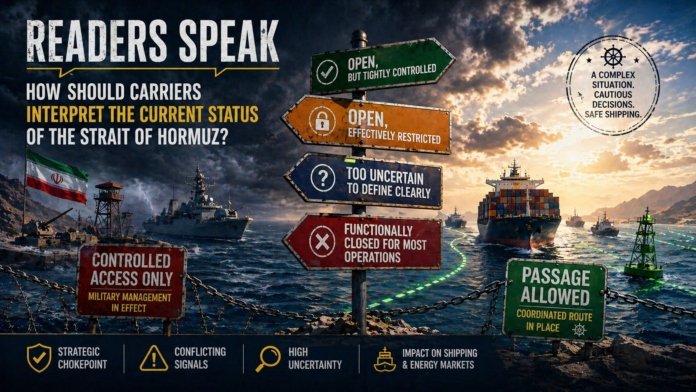
Conflicting signals around the Strait of Hormuz continue to shape industry perception. In the latest Readers Speak poll, participants were asked how carriers should interpret the current status of the strategic waterway.
The results point to a clear conclusion: most readers view the Strait as effectively closed or too uncertain for normal operations.
Readers Speak: U.S. blockade seen as regional shipping disruption
Majority see the route as functionally closed
The dominant view among respondents is that the Strait is functionally closed for most operations.
Despite official statements suggesting controlled or conditional access, readers appear to believe that the level of restriction, risk, and unpredictability effectively prevents normal commercial use.
This reflects a practical interpretation: even if passage is technically possible, it may not be operationally viable.
High level of uncertainty reinforces cautious stance
A significant share of respondents describes the situation as too uncertain to define clearly.
This highlights the impact of:
- conflicting official statements
- rapidly changing conditions
- lack of consistent enforcement clarity.
For many in the industry, the absence of a stable and predictable framework makes planning extremely difficult.
Limited support for “controlled openness”
Only a small portion of respondents view the Strait as open, even under tight control or restrictions.
This suggests that confidence in managed or coordinated transit remains low, with most participants unconvinced that current arrangements provide sufficient reliability for regular operations.
Perception outweighs technical status
The results underline a key point:
market perception is diverging from official positioning.
While authorities may frame the Strait as open under certain conditions, industry participants are assessing the situation based on:
- operational risk
- consistency of access
- and real-world feasibility.
A corridor in name, but not in practice
Taken together, the findings suggest that the Strait is viewed less as an open corridor and more as a high-risk, restricted environment.
For carriers, the distinction between “open” and “usable” is becoming increasingly important, and in the current context, many see the two as fundamentally different.
Conclusion
Readers send a clear message:
the Strait of Hormuz may not be formally closed, but for many, it is not a viable route under current conditions.
Until clarity and stability improve, the industry is likely to continue treating the corridor with caution, prioritizing predictability over theoretical access.