

Industry sees higher costs becoming the dominant response
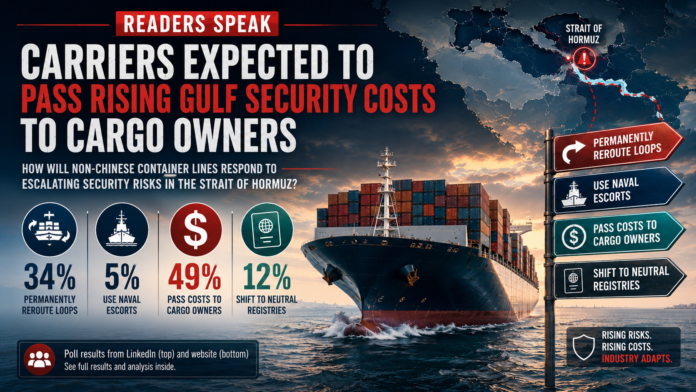
The latest Readers Speak poll explored how non-Chinese container carriers are expected to respond to escalating security risks in the Gulf region.
The results point to a clear industry expectation:
most readers believe carriers will increasingly pass rising operational and security costs directly to cargo owners.
As instability continues across the Gulf and the Strait of Hormuz, respondents appear to view cost transfer as the most likely long-term commercial response.
Passing costs to cargo owners leads the outlook
The strongest response from participants focused on the expectation that carriers will continue shifting the financial burden of regional instability onto shippers and cargo owners.
This reflects growing concerns over:
- rising war-risk premiums
- increased insurance costs
- security-related operational expenses
- and the financial impact of prolonged geopolitical uncertainty.
For many readers, elevated pricing now appears increasingly embedded into the commercial reality of operating in the region.
Permanent rerouting also seen as a major strategy
A significant share of respondents expects carriers to permanently reroute service loops away from high-risk Gulf areas.
The findings suggest many industry observers believe temporary contingency measures may gradually evolve into longer-term network adjustments as carriers prioritize operational predictability and risk reduction.
This reflects broader concerns surrounding:
- vessel safety
- schedule reliability
- and exposure to future disruptions.
Limited confidence in naval escorts
Only a small portion of participants identified naval protection as the preferred long-term solution.
This may indicate skepticism over whether military escort operations alone can provide sustainable commercial confidence for carriers operating in the region.
Neutral registries receive mixed support
The option of shifting vessels to neutral registries attracted comparatively limited support among respondents.
This suggests readers largely view operational and commercial adjustments, rather than registry changes, as the more practical industry response to escalating tensions.
Industry increasingly focused on commercial resilience
The results highlight how the conversation is evolving beyond immediate disruption and toward long-term operating models.
Rather than expecting a rapid return to stability, many readers appear to believe carriers will adapt through:
- pricing strategies
- network redesign
- and broader risk management measures.
Conclusion
Readers send a clear message:
the container shipping industry is expected to respond to escalating Gulf security risks primarily through higher costs and long-term operational adjustments.
As geopolitical instability persists, commercial resilience increasingly appears to be replacing short-term crisis management as the industry’s central focus.