
The Port of Barcelona Management Board has initiated the tender process for a major road junction valued at EUR€98 million excluding VAT, representing the most significant road infrastructure project in the port’s history.
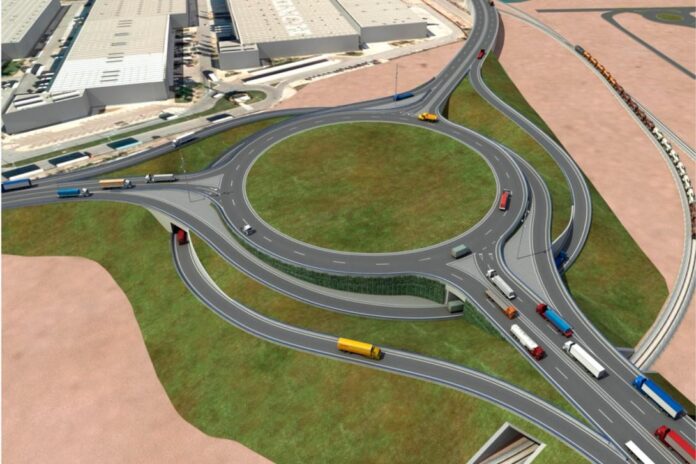
The works involve the construction of a large raised roundabout over the former mouth of the Llobregat River, designed to manage increased vehicle traffic in the southern port area resulting from new road accesses, the future Catalunya wharf and the expansion of facilities at the Prat wharf.
The construction period is estimated at three and a half years, and given the project’s value, the tender requires approval by the Council of Ministers.
The raised roundabout will feature three main entrance and exit branches.
The first will connect to the future port access highway, the second to the container terminals in the southern area, and the third, provisionally, to the terminals north of the old river mouth.
The final northern connection, in the form of an elevated viaduct, will be built following the future construction of pontoon-type mooring point 35B.
The infrastructure will also incorporate a large service gallery enabling underground interconnection beneath the junction and the planned railway complex to be developed in the former Llobregat riverbed.
In a separate decision, the Management Board awarded a contract worth EUR€111.5 million to FCC and COMSA for the construction of three new liquid bulk berths on the east side of the Energy wharf, to be completed in three years and two months.
The new berths will be dedicated primarily to the loading and unloading of sustainable fuels, advancing the port’s decarbonisation agenda and reinforcing its positioning as an energy hub for southern Europe and the Mediterranean.
Once operational, the expanded capacity will allow the west side berth 32 to be repurposed exclusively for chemical and agri-food operations, and will create the conditions for a new car carrier berth in the inner basin to accommodate rising vehicle import volumes.