
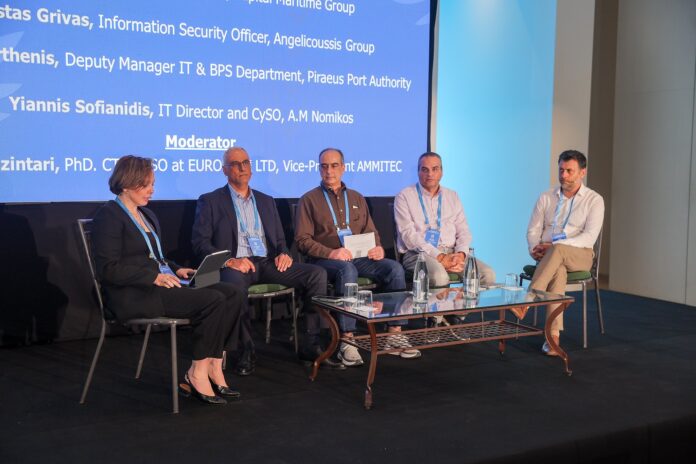
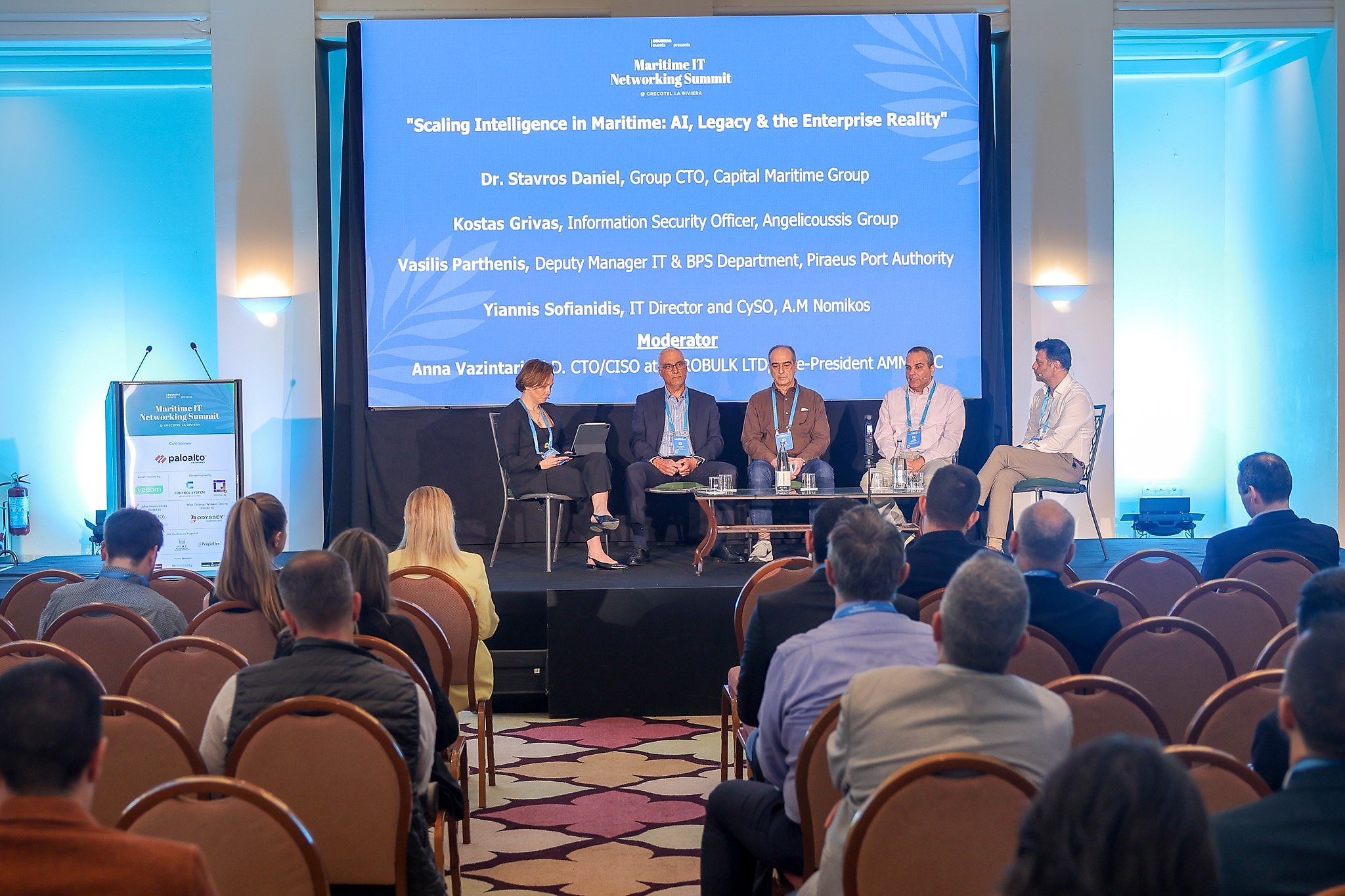
The intersection of centuries-old maritime operations and rapid technological automation took center stage at the recent Maritime IT Networking Summit, held at the Grecotel La Riviera resort in Greece.
During the panel discussion titled “Scaling Intelligence in Maritime: AI, Legacy & the Enterprise Reality” moderated by Dr. Anna Vazintari, PhD, CTO/CISO at EUROBULK LTD and Vice-President of AMMITEC, technical executives focused on analyzing commercial automation trends while addressing the practical, backend operational challenges of deploying Artificial Intelligence (AI) across legacy-heavy enterprise infrastructures.
Moving Beyond the Hype: Practical Time-to-Value
The discussion quickly established that AI has rapidly evolved past simple experimental phases into active deployment. Dr. Stavros Daniel, Group CTO of Capital Maritime Group, emphasized that corporate reporting requirements and C-level expectations are actively driving this transition. According to Dr. Daniel, AI is no longer just a trend; it is a permanent enterprise reality.
The panel outlined several concrete applications where data-driven intelligence is already yielding measurable optimization:
-
Route Optimization: Modern systems combine sea currents, weather data, historical vessel speeds, and fuel pricing to generate precise, real-time voyage routing recommendations.
-
Predictive Maintenance: Automated algorithms continuously monitor engine sensors to flag performance anomalies, allowing onshore teams to prevent catastrophic equipment failures before they occur.
-
Crew Assistance: Conversational AI assistants are being deployed to streamline continuous onboard reporting, easing administrative burdens for crews at sea.
Market Maturity and the Essential Human Element
Despite rapid technological progress, the speakers urged the industry to maintain an objective view of current adoption rates. Yiannis Sofianidis, IT Director and CySO at A.M. Nomikos, noted that while approximately half of maritime organizations are experimenting with AI in pilot programs, full-scale implementation remains concentrated within larger, highly structured fleets.
A significant barrier to wider adoption is user uncertainty regarding data classification. Sofianidis argued that traditional training methods, such as distributing static PDF policies, fail to alter user behavior. Instead, he advocated for hands-on training with real-world examples to help teams distinguish between safe productivity use cases (like drafting daily correspondence) and dangerous practices, such as uploading sensitive claim documents or proprietary corporate records into public large language models.
The panel unanimously agreed that keeping a human-in-the-loop remains vital. Fleet managers must retain final operational control over AI-generated outputs, as the technology is not yet mature enough to operate autonomously without human verification.
Port Infrastructure: Breaking Down Complex Silos
The digital transformation expands far beyond the vessel itself, directly impacting port operations and multi-stakeholder supply chains. Vasilis Parthenis, Deputy Manager of the IT & BPS Department at the Piraeus Port Authority, described ports as highly complex ecosystems involving customs, coast guards, agents, and terminal operators.
Parthenis clarified that AI will not replace the deeply established operational rules that govern these networks. Rather, intelligent applications are designed to layer on top of existing frameworks to accelerate communication and cargo processing times.
The Piraeus Port Authority is currently evaluating market solutions for Yard Optimization and Scheduling to better manage limited physical terminal space. The port is also actively building Digital Twin platforms to simulate and automate logistical decisions. Parthenis shared that a recent five-month market investigation revealed a rapid acceleration in vendor capabilities, with suppliers embedding far more robust and mature AI agents into their software packages over a short period.
Mitigating Corporate Risk: Shadow AI and Governance
The rapid, unmanaged proliferation of public AI tools has introduced a new corporate challenge: Shadow AI. To counter the unregulated use of public chatbots by shore staff and crews, leading shipping groups are adjusting their corporate governance models.
Kostas Grivas, Information Security Officer at the Angelicoussis Group, revealed that his organization established a dedicated AI committee to oversee corporate strategy, evaluate vendor platforms, and maintain control over data integrity. Grivas stressed that corporate data is a shipping company’s core asset, requiring rigorous protection.
To balance employee productivity with strict information security, several maritime enterprises are opting for controlled rollouts of integrated solutions like Microsoft 365 Copilot to handle email summarization and manage daily communication overloads.

Concurrently, IT teams are initiating Data Loss Prevention (DLP) projects utilizing automated data classification to map out company data flows without disrupting daily business workflows. Grivas also highlighted backend Application Programming Interfaces (APIs) as crucial digital blind spots that require thorough third-party risk assessments, given that security vulnerabilities typically emerge at the processing layer rather than the user interface.
Quantifying the Return on Investment (ROI)
The panel concluded with an in-depth analysis of how shipping lines can accurately measure the financial return on their technology investments. While calculating exact metrics remains challenging in the early stages, executives noted that ROI can be effectively tracked within specialized, vertical use cases—such as measuring saved man-hours through IT helpdesk chatbots.
Ultimately, the executive consensus indicated that the true value of scaling intelligence in maritime operations extends far beyond simple cost reduction or labor replacement. The overarching benefit lies in the corporate ability to make faster, highly consistent, and data-backed decisions that minimize operational risk across the global supply chain.