
The rapid digital transformation of the shipping industry has officially bridged the gap between traditional mechanical engineering and interconnected cyber-physical platforms. However, this convergence brings unprecedented security challenges. Understanding the balance between operational efficiency and the escalating landscape of maritime cybersecurity and AI threats has become the industry’s most critical objective.
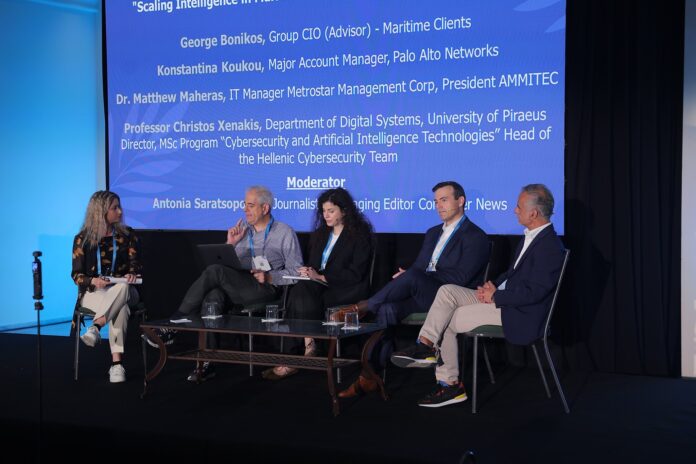
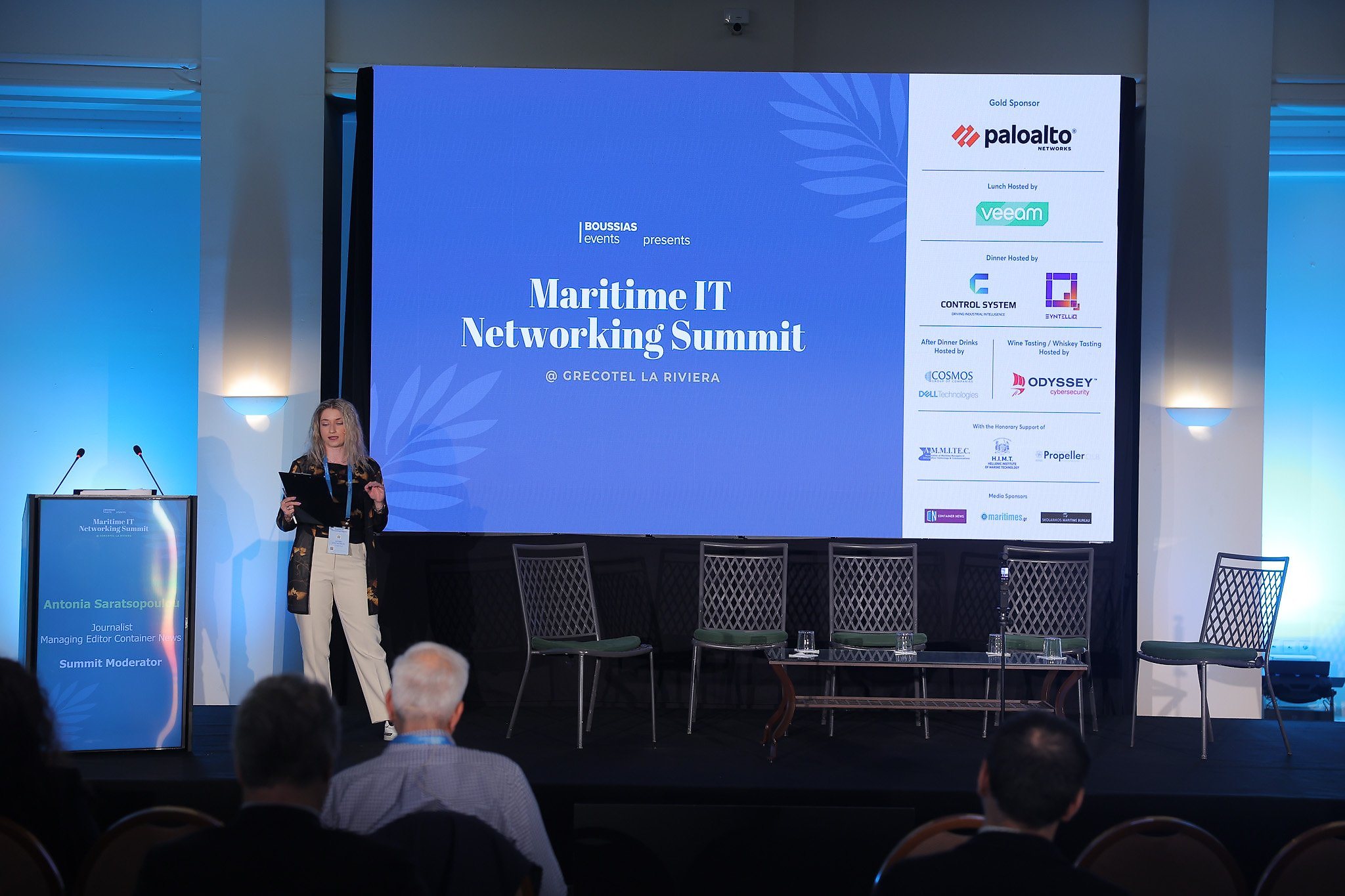
At the recent Maritime IT Networking Summit held at the Grecotel La Riviera in Greece, a panel of leading industry experts and academics gathered to dissect these digital blind spots.
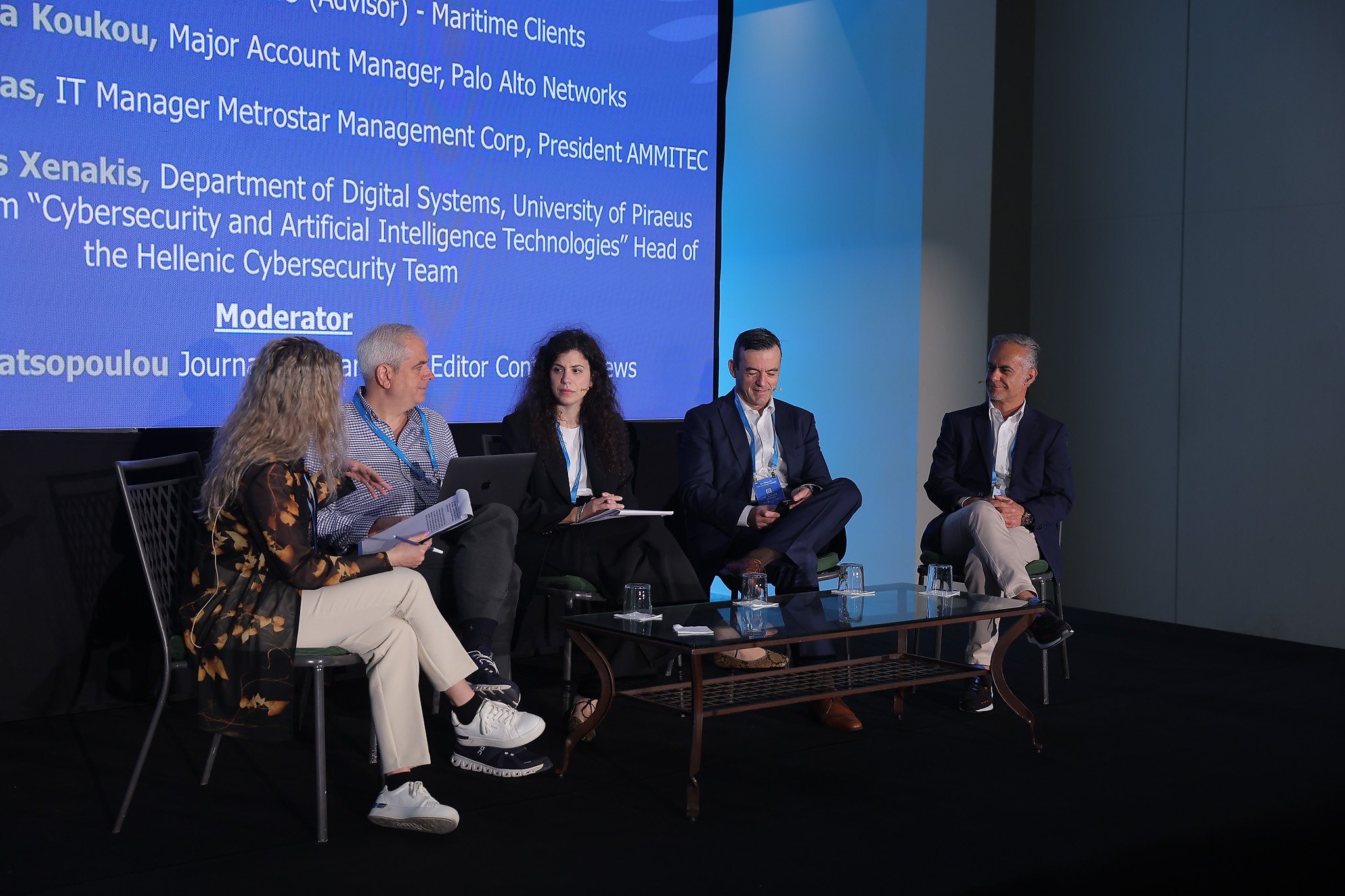
The panel, structured as a Futurist Chat titled “Future Pathways in Maritime Security: Strengthening Digital Trust in the Maritime Ecosystem,” was moderated by Antonia Saratsopoulou, Managing Editor of Container News and the overall summit moderator. The discussion made one thing clear: mere regulatory compliance no longer equates to true operational readiness against sophisticated modern attacks.
The Moving Infrastructure Challenge
The maritime sector operates in an entirely different reality compared to land-based critical infrastructure. George Bonikos, Group CIO (Advisor) – Maritime Clients, emphasized that a vessel is essentially a “moving piece of critical infrastructure.”
Ships operate with limited or fluctuating connectivity, rely heavily on fragmented legacy systems, and function outside a static IT perimeter.
Furthermore, mitigating maritime cybersecurity and AI threats is uniquely complex because it involves a deeply fragmented ecosystem of stakeholders—owners, managers, charterers, ports, and cargo owners, whose operational priorities often conflict.
“A single cyber incident at sea does not just lock an office computer; it triggers a catastrophic domino effect capable of paralyzing sections of the global supply chain.” said George Bonikos.
The Utopia of the IT vs. OT Separation
One of the panel’s most critical insights centered on the flawed practice of copying land-based IT (Information Technology) frameworks and pasting them directly onto a ship’s OT (Operational Technology) environment.
Dr. Matthew Maheras, IT Manager at Metrostar Management Corp. and President of AMMITEC, labeled these rigid approaches as “utopian.” He explained that when a standard IT security manual advises isolating or shutting down a compromised system for remediation, it is practically asking a crew to leave a vessel uncommanded and drifting in the middle of the ocean.
Expanding on this vulnerability, Konstantina Koukou, Major Account Manager at Palo Alto Networks, identified the ship’s OT environment as the ultimate modern blind spot where maritime cybersecurity and AI threats can cause physical harm.
-
The Visibility Gap: Traditional security defenses fail because they lack deep visibility into maritime proprietary protocols.
-
The Priority: Achieving comprehensive application and asset visibility is the absolute baseline. As Koukou noted: “You cannot protect what you cannot see.”
-
Third-Party Risks: Unmonitored remote access granted to external vendors for routine maintenance remains a massive, unvetted vulnerability. Shifting to a strict Zero Trust model—built on continuous verification and network segmentation—is no longer optional.
Weaponized AI and the Democratization of Cybercrime
The debate took a sharp turn into the double-edged sword of Artificial Intelligence, introduced by Professor Christos Xenakis from the Department of Digital Systems at the University of Piraeus, Director of the MSc Program “Cybersecurity and Artificial Intelligence Technologies,” and Head of the Hellenic Cybersecurity Team.
Professor Xenakis warned that AI is acting as a massive force multiplier for threat actors, effectively democratizing cybercrime and reshaping how we view maritime cybersecurity and AI threats.
[Traditional Cyberattack] -> Requires Advanced Technical Expertise & Time
[AI-Driven Cyberattack] -> Lower Technical Barrier + Rapid Automated Execution
Through a realistic case study, Professor Xenakis illustrated how a breach of structural blueprint data for a sister-ship fleet of 30 to 40 vessels could be weaponized. An attacker without elite coding skills can feed those blueprints into commercial Large Language Models (LLMs) like ChatGPT or Claude to map out exact OT vulnerabilities, script tailored exploits, and execute localized port-side attacks.
“History shows that criminals are natural innovators because they adopt new tech first. Just like 1930s gangsters bought the fastest cars while police forces lagged behind, modern cybercriminals leverage AI to run highly efficient, low-cost operations.” said Prof. Christos Xenakis.
Compounding this threat is the systemic failure of traditional defense mechanisms like SIEM and IDS. These platforms flood maritime IT teams with hundreds of noisy, false-alarm alerts daily, leading to alert fatigue. Because everyone eventually ignores the noise, sophisticated AI-driven attacks are specifically designed to slip entirely under the radar.
Insider Threats: Shadow AI and Data Poisoning
While external hackers dominate headlines, the panel highlighted severe internal risks, proving that maritime cybersecurity and AI threats can originate from within the corporate office.
Dr. Matthew Maheras explained that unlike Shadow IT, which could be blocked or monitored at the corporate network level, Shadow AI bypasses traditional firewalls. Well-meaning shore executives (like CFOs) or onboard engineers frequently upload sensitive corporate documents—such as charter parties, legal contracts, or maritime insurance policies—into public AI tools to quickly summarize or draft replies.
This creates immediate corporate data leakage. The confidential data is absorbed into public training sets, and relying on unverified AI outputs risks introducing costly legal hallucinations.
Furthermore, as deep learning algorithms are integrated directly into vessels for predictive maintenance on main engines, the threat of Data Poisoning emerges. If an attacker alters the baseline training data of an engine-monitoring model, the system can be manipulated to report perfect health while the machinery is actually heading toward catastrophic failure mid-ocean.
Conclusion: Cultivating an Operational Cyber-Culture
The consensus from the Maritime IT Networking Summit is definitive: managing maritime cybersecurity and AI threats has outgrown the IT department.
Securing the future of shipping requires a top-down, bottom-up Cyber and AI Governance culture. This strategy must seamlessly link the CEO and CFO in the shore office to the Captain and Third Engineer on the vessel.
In an era where adversaries innovate at the click of a button, relying on fragmented technical fixes without unified corporate governance offers nothing more than a dangerous illusion of safety.