
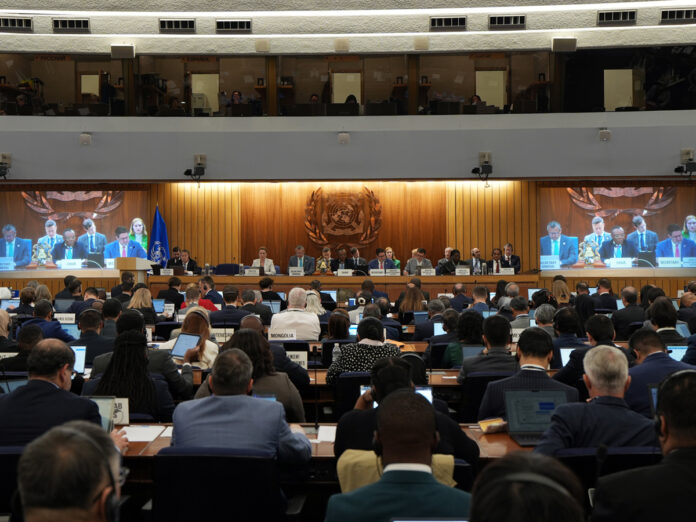
The 84th session of the International Maritime Organization Marine Environment Protection Committee (MEPC) ended with renewed momentum toward a global agreement on shipping emissions.
Meeting in London from 27 April to 1 May, the committee agreed to rebuild consensus on greenhouse gas (GHG) reduction measures, while advancing a wide range of environmental regulations.
Emissions talks regain momentum
Nearly 100 delegations discussed the proposed IMO Net-Zero Framework, which aims to cut emissions from international shipping.
IMO Secretary-General Arsenio Dominguez said the process is moving forward again but requires stronger alignment among member states.
The committee agreed to:
- Set up an intersessional working group
- Hold meetings in September and November 2026
- Continue negotiations ahead of MEPC 85 in late November
The next extraordinary session is scheduled for December 2026.
Strait of Hormuz risks highlighted
The committee adopted a resolution condemning attacks on commercial shipping in the Strait of Hormuz.
Members warned that escalating tensions could trigger major marine pollution incidents, including oil spills and hazardous material releases.
The IMO will monitor environmental impacts and report developments to its Council.
New North-East Atlantic emission control area
MEPC approved a new Emission Control Area (ECA) in the North-East Atlantic.
The zone will cover waters up to 200 nautical miles from:
- Greenland
- Iceland
- Ireland
- United Kingdom
- France, Spain, and Portugal
From 2027–2028, ships operating in the area must:
- Use low-sulphur fuel (max 0.10%)
- Reduce NOx, SOx, and particulate emissions
The move aims to improve air quality and reduce health risks.
Action on plastics and pollution
The committee adopted a new 2026 Strategy on Marine Plastic Litter, targeting zero plastic discharge from ships by 2030.
It also agreed to:
- Develop a mandatory code for transporting plastic pellets
- Strengthen port waste reception and compliance systems
- Expand training and international cooperation
Further measures on marine protection
Additional decisions included:
- Updates to the Ballast Water Management Convention to limit invasive species
- Progress on reducing underwater radiated noise (URN) from ships
- New work on biofouling management
- Plans to regulate autonomous vessels (MASS)
The committee also approved guidelines for measuring methane (CH₄) and nitrous oxide (N₂O) emissions from marine engines.
Industry faces complex path ahead
While progress was made, global agreement on emissions remains complex.
Geopolitical tensions, fuel transitions, and regulatory alignment continue to shape negotiations.
Still, IMO members signaled a clear intent to advance environmental regulation while maintaining momentum toward net-zero shipping goals.