

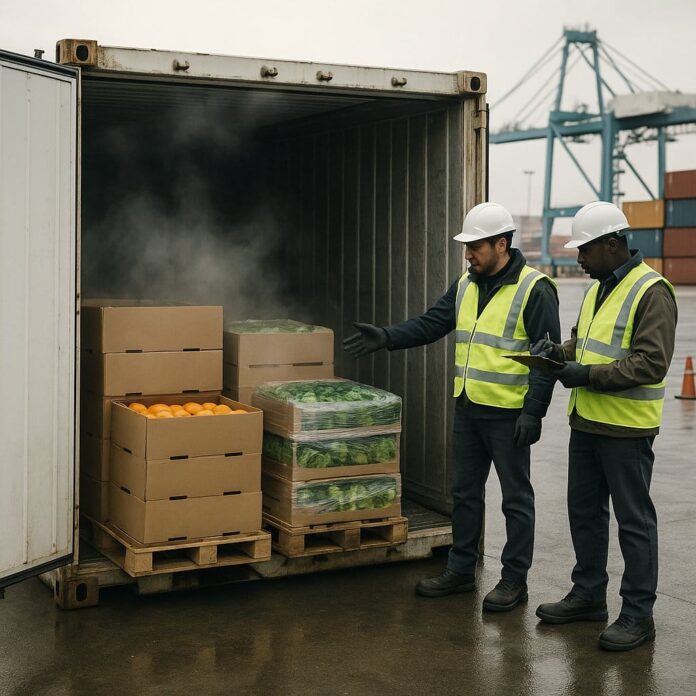
A refrigerated container that arrives out of temperature range is usually discussed as a cargo loss. The invoice value of the load, however, is only one line in the final accounting. By the time a rejected reefer has worked its way through claims, the bill can also include survey and inspection fees, disposal or salvage handling, demurrage while the dispute sits unresolved, replacement shipment costs on premium routings, and — hardest to price — the customer relationship attached to the delivery window that was missed.
The scale of the underlying problem is well documented. The FAO estimates that around 14 percent of the world’s food is lost between harvest and retail, a share in which post-harvest handling and transport figure prominently. On the pharmaceutical side, a widely cited IQVIA Institute estimate puts the biopharma industry’s annual losses linked to failures in temperature-controlled logistics at roughly US$35 billion. Individual rejected loads are where those aggregate numbers land on specific shippers, carriers, and forwarders.
Where the money actually goes
The claims file of a typical rejected reefer load shows a consistent pattern. The cargo value anchors the claim, but the surrounding costs compound it: surveyors on both ends, cold store time while samples are tested, destruction certificates for product that cannot be salvaged, and the cost of the replacement shipment — often airfreighted or expedited at multiples of the original ocean rate because the delivery commitment still stands.
A simplified illustration shows how the multiplication works. Take a hypothetical rejected load of chilled produce invoiced at $60,000. Surveys on both ends might add $2,000 to $4,000. A week of cold store time and testing adds more. If the product is condemned, disposal is charged, not credited. If the delivery commitment stands, a replacement shipment moves on expedited routing at a multiple of the original freight cost. If the dispute drags, demurrage and legal review accumulate on top. These are illustrative figures rather than benchmarks — every lane and commodity prices differently — but the structure is consistent: the secondary costs scale with time, and time is exactly what a disputed claim consumes.
Then comes the least visible entry. Allocation of liability between shipper, carrier, and receiver frequently turns on evidence that does not exist. The reefer controller may record supply- and return-air temperatures, setpoints, and machinery events, but those readings do not establish conditions at carton or product-core level throughout the load. The shipper’s pre-cooling records end at the terminal gate. The receiver’s dock reading starts at destination. Between those points sits the majority of the transit — and, in a disputed claim, an evidentiary gap that each party fills with its own assumptions.
Disputes are priced into the trade
That gap has a market price. Unresolved liability shows up as longer settlement cycles, higher insurance premiums on lanes with claim history, and commercial friction that outlasts any single shipment. Perishables shippers change forwarders over disputed rejections; receivers tighten acceptance criteria; carriers face claims where the vessel and the reefer machinery performed exactly as specified.
Since some share of excursions is inherent to multi-handoff transport, the more realistic lever is converting disputed losses into documented ones. A timestamped condition record tied to a location and a door event does not by itself decide liability — calibration, device placement, and contractual terms still matter — but it narrows the argument to facts, and claims with a shared factual record are generally easier to settle than claims built on competing assumptions.
The monitoring layer that narrows the gap
Shipment-level condition monitoring has accordingly moved from a premium option toward common practice on high-value cold chain lanes. A growing category of hardware travels with the load itself, complementing asset-mounted reefer telemetry: multi-sensor devices recording temperature, humidity, light, shock, and position, reporting over cellular networks in transit and logging locally through coverage gaps at sea. What separates hardware generations is less the sensor list than the timeline — readings recorded against a shared timebase can be aligned with door events and positions afterwards, while fragmented data from separate devices reopens the same evidentiary gaps.
The commercial arithmetic is lane-specific. Device and connectivity cost per shipment is typically small relative to reefer cargo values, and against it sits the expected cost of a disputed rejection — the full claims file, not the cargo alone. Where disputes recur on a lane, documented condition records can offset the monitoring cost quickly; on lanes that rarely see a claim, the case rests instead on operational visibility. Devices in this category increasingly reflect the claims scenario: Eelink’s GPT45-M cold chain cargo tracker, for example, records seven sensor channels against a single timebase according to its published specifications, so a temperature excursion in the record can be aligned with a door opening and a position when the file is reviewed.
What to weigh before deploying
Three practical points separate monitoring programs that reduce claims costs from those that merely add data. Carton-level and shipment-level readings answer different questions — a device at the pallet cannot see a frozen edge carton, so high-value loads may justify both layers. Calibration, device placement, and how the record is handled all affect the weight the data carries when a claim is contested. And data ownership matters at claim time: records that land in the shipper’s own systems, rather than a third party’s closed platform, are available on the shipper’s schedule when the dispute begins.
A short evidence protocol, agreed before the load ships, multiplies the value of whatever hardware is deployed. At minimum it records the device serial number, its placement in the load, activation time, and the data format the parties will accept if a claim arises. None of that costs anything at booking; all of it is expensive to reconstruct after a rejection.
Whatever happened to the cargo in a rejected reefer happened before the doors opened at destination. The rest of the claims file is where cold chain operators still have room to take cost out — and while evidence handling after arrival matters too, whether a loss ends up contested or documented is shaped in large part before the load ships.