
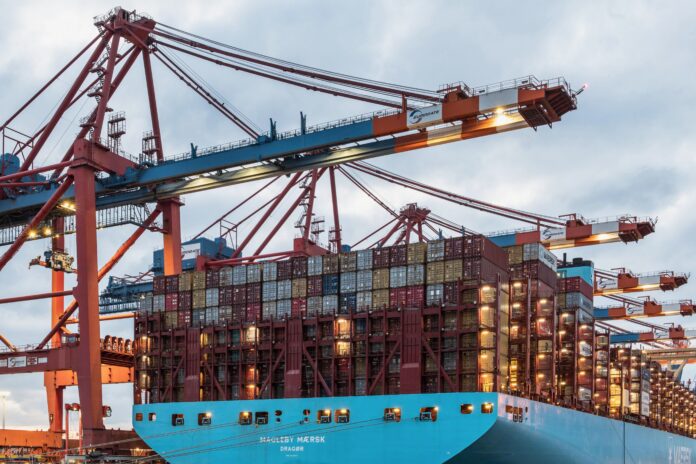
Anyone who has tracked a container past the quay knows the moment. The box clears customs, everyone breathes easy, and then it sits. Stuck in a drayage queue. Or piled up at a rail ramp with no clear timeline for movement. That handoff, the one between “cleared the port” and “actually moving inland,” has quietly become the moment that decides whether cargo flows smoothly or turns into a costly headache.
The pressure hasn’t gone away in 2026. It just moved further down the chain, past the gate, into territory that used to get far less attention than it deserves.
The Shift from Gateway Ports to Inland Networks
For years, the industry fixated on berths and vessel bunching at the big gateway terminals. That conversation has changed. A recent analysis from Maersk put it plainly: the first wave of supply chain diversification centered on ports themselves, but the next wave is about everything that happens once cargo leaves them.
That framing lines up with the Container Port Performance Index 2025, a joint effort between the World Bank and S&P Global. The report describes a relationship that runs both directions. Long vessel turnaround times push delays straight into the inland network, while good coordination between ports and rail or truck partners acts almost like a shock absorber for the whole system.
Some companies are leaning into this shift rather than getting caught flat-footed. Freight brokers like Vesta Freight, for instance, work with shippers and carriers to strengthen internal processes while tackling logistics problems with a mix of technology and dependable capacity. Not glamorous work, but the kind of groundwork that keeps cargo moving when the network gets twitchy.
Recent Congestion Patterns and Their Inland Ripple Effects
Congestion didn’t disappear. It just changed shape. Reporting from The Loadstar in late June found congestion across major Asian and European hubs stranded roughly 3.4 million TEU of capacity. Shanghai saw waits stretch to four or five days, while other ports ran anywhere from three to seven. Add in yard density problems and equipment imbalances, and the friction doesn’t stop just because a box technically cleared the terminal.
None of that stays contained to the ocean side for long. A 2026 analysis titled “From Port to Final Mile” walked through how compressed discharge windows from bunched vessel arrivals overwhelm drayage capacity almost immediately. Chassis shortages worsen during volume surges, and rail ramps deal with dwell times that swing wildly whenever inbound freight arrives in uneven waves rather than a steady trickle.
This plays out in real time at inland hubs tied to shifting trade lanes. Journal of Commerce reported in July that as import volumes drift back toward certain West Coast gateways, facilities feeding major rail hubs, Chicago being a prime example, are running into tighter equipment availability and real challenges scaling drayage fast enough.
Why Intermodal Optionality Is Gaining Ground
Shippers are responding by increasing their use of intermodal rail where conditions allow. Data tracked by FreightWaves in mid-July showed domestic loaded rail container volumes rising around 13 percent year-over-year in June. On major corridors, domestic intermodal pricing has run roughly 30 percent below over-the-road truckload rates, encouraging more conversion as companies balance cost and capacity needs.
Longer sea voyages are adding urgency. UNCTAD’s Review of Maritime Transport 2025 documented how average voyage hauls grew from 4,831 miles in 2018 to 5,245 miles by 2024 amid geopolitical rerouting. During disruptions, the same report found average port waiting times rose by 23 percent in developed economies, placing greater strain on inland connections. These ongoing cost pressures are also reflected in recent carrier adjustments, including updates to intermodal fuel fees.
A few pressures worth keeping on the radar right now:
- Compressed discharge windows that create sudden spikes in drayage demand
- Equipment and chassis imbalances that worsen when trade flows shift between coasts
- Rail dwell volatility tied to network conditions and unpredictable volume surges
- The ongoing need for visibility across modes, so exceptions get caught before they turn into demurrage or missed appointments
Building Stronger Inland Networks
The operators pulling ahead are treating the inland leg as a genuine extension of the ocean move rather than an afterthought. That means building real optionality across rail, truck, and other modes, and positioning inventory at inland hubs that act as a buffer when things go sideways. Secondary locations, once viewed as a backup plan at best, are becoming a lot more important simply because they give companies somewhere to go when the primary corridor gets clogged.
There’s a sustainability angle here too, one that tends to get overlooked amid all the talk about speed and cost. The Intermodal Freight Transportation Market Research Report, covering 2025 through 2034 and published by Dataintelo, noted that rail-road combinations already hold the largest share of intermodal activity, partly because rail produces meaningfully lower emissions per ton-kilometer than long-haul trucking. The smart inland strategy and the greener one tend to point in the same direction, which is a nice change of pace.
What This Means for Your Operations in 2026
The pattern this year is fairly clear, even if it’s not always comfortable to admit. Companies planning the inland segment with the same rigor once reserved for vessel and port selection are keeping their flows reliable. Earlier coordination with partners who understand both ocean schedules and domestic constraints, paired with visibility technology that follows the shipment the whole way, makes a real difference.
If the port gate still feels like the finish line rather than a transfer point, staying reactive gets more expensive by the month. Thoughtful intermodal flexibility is already producing smoother movements, less exposure to accessorial charges, and resilience that’s hard to fake when things go wrong.
Professionals who map their current handoff points, then actually test partners capable of scalable, multi-mode capacity, tend to be a step ahead when disruption hits. Change beyond the port gate isn’t a question of if anymore. It’s a question of how fast you position yourself to benefit from it.