
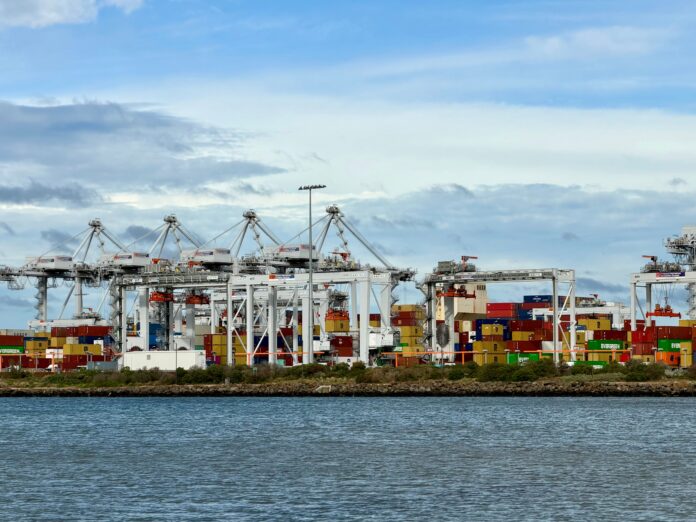
Global shipping does not end when a vessel reaches its berth. For machinery, industrial equipment, transformers, cranes, and other oversized cargo, the most difficult part of the journey often begins at the port gate. Ocean carriers can move massive loads across continents, but shippers still need a safe and practical way to reach factories, construction sites, mines, farms, and energy projects inland.
This final stage requires more than a standard container chassis and highway tractor. It calls for accurate cargo data, suitable trailer equipment, route planning, permits, lifting coordination, and close communication across the supply chain.
Ocean Freight Solves Only Part of the Problem
Shippers usually move heavy equipment by roll-on/roll-off (RoRo) service, breakbulk vessel, flat-rack container, or open-top container. Each method serves a different cargo profile.
RoRo works well for equipment that can drive or roll onto a vessel. Breakbulk shipping supports units that exceed container dimensions or require crane handling. Flat racks and open-top containers suit cargo with unusual height or width that still fits within a container-based operation.
However, the inland plan must match the ocean plan from the start. A machine may fit safely on a flat rack but exceed legal road height on a standard trailer. A port crane may handle the weight, while the destination lacks suitable unloading equipment. A direct route may include low bridges, tight turns, weak roads, or local restrictions.
Successful project cargo planning treats the vessel, terminal, trailer, route, and delivery site as one connected system.
When Standard Container Equipment Reaches Its Limit
Standard chassis work efficiently for regular 20-foot and 40-foot containers. They support high-volume transfers between ports, rail terminals, warehouses, and distribution centers.
Oversized cargo creates different demands. Height often causes the first problem. Shippers need to keep tall equipment as close to the road as possible to clear bridges and utility lines. Weight also matters because concentrated loads can exceed axle limits even when the total weight appears manageable.
Removable gooseneck trailers address both challenges. Their low deck height reduces overall loaded height, while their detachable front section allows equipment to drive onto the deck from ground level. This design can reduce crane use for self-propelled machinery and simplify loading at sites with limited lifting infrastructure.
Carriers and project planners comparing equipment options can review rgn trailers for sale to understand the deck layouts, axle configurations, and capacity ranges available for heavy-haul operations.
Cargo Data Must Drive Trailer Selection
A project team should never select a trailer based on weight alone. The team needs a complete cargo profile before it books inland transport.
That profile should include:
- Total weight
- Length, width, and height
- Center of gravity
- Ground clearance
- Contact points
- Lifting and tie-down locations
- Ability to move under its own power
- Sensitivity to vibration, weather, or tilt
The center of gravity can change how a trailer handles turns and braking. Low ground clearance can complicate loading. Narrow contact points can place too much pressure on a small deck section. A machine with tracks may load easily, while a non-running unit may require a winch, crane, or hydraulic skidding system.
The trailer must support the cargo and distribute the weight across the permitted axle group. Extra axles can increase capacity, but they also increase turning space and route complexity. A longer combination may struggle at port exits, urban intersections, or construction sites.
Route Surveys Protect Schedules and Budgets
The shortest route rarely provides the best route for oversized freight. Heavy-haul planners must evaluate every physical and regulatory obstacle between the terminal and the delivery point.
A proper route survey examines bridge clearances and load ratings, road width, turning radius, railroad crossings, utility lines, construction zones, seasonal restrictions, and destination access.
Permit rules vary by state and local jurisdiction. Some loads require pilot cars, police escorts, engineering reviews, or daylight-only travel. Large projects may require temporary sign removal, utility work, or access-road reinforcement.
These details affect more than the trucking rate. They influence port storage, crane bookings, labor schedules, escort costs, and installation work. One missed permit or overlooked bridge can delay the entire project.
Port Coordination Can Prevent Expensive Delays
Ports operate under strict schedules, security rules, and space constraints. Oversized cargo often needs a specific pickup window, approved equipment, and advance documentation. The carrier may also need terminal access credentials and confirmation that the trailer can enter the assigned area.
The project team should confirm who will lift or roll the cargo onto the trailer. It should also verify equipment capacity, rigging, and the loading sequence. Poor coordination can leave a truck waiting while terminal charges continue to rise.
Communication matters most when several contractors share responsibility. The ocean carrier, freight forwarder, customs broker, terminal operator, heavy-haul carrier, escort provider, and destination team must use the same dimensions, weights, and schedule.
Heavy-Haul Trucking Supports the Wider Freight Network
Trucking remains the main connector between ports and inland destinations in the United States. The American Trucking Associations reports that trucks moved about 72.7% of domestic freight by weight in 2024, or an estimated 11.27 billion tons. This scale shows why road transport plays a central role in both container logistics and project cargo.
Standard trucking handles most freight volume, but specialized trailers carry the loads that standard equipment cannot move safely. These shipments support construction, manufacturing, power generation, agriculture, mining, and infrastructure development.
The same port may process consumer goods in containers, vehicles through RoRo terminals, and industrial components as breakbulk cargo. Each shipment enters a different inland network, yet all depend on coordination between maritime and road transport.
Better Planning Creates More Predictable Delivery
Heavy cargo always carries operational risk, but better planning makes that risk manageable. Teams should involve the inland carrier before they finalize the ocean booking. Early input can identify height problems, unloading limitations, axle requirements, and route restrictions before the cargo reaches the port.
Digital tools help planners compare routes, track permits, share cargo drawings, and monitor delivery progress. Still, software cannot replace field knowledge. An experienced heavy-haul team understands how trailer geometry, road conditions, weather, and cargo behavior interact in real operations.
The best transport plan balances safety, cost, and schedule. It avoids unnecessary handling, selects equipment around the cargo, and gives every contractor clear responsibilities.
The Port Gate Is a Transfer Point, Not the Finish Line
Container shipping connects global markets, but specialized inland transport completes the journey. For oversized machinery and project cargo, the move from port to site can demand more engineering and coordination than the ocean voyage itself.
Shippers that plan both stages together gain better control over cost, timing, and risk. They also reduce the chance that cargo reaches the port successfully but cannot continue to its final destination.
A strong project cargo strategy starts with one principle: plan the road move before the vessel sails.