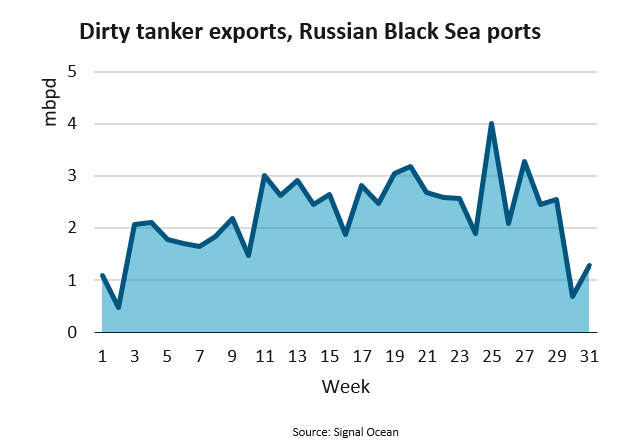

Dirty tanker loadings from Russian ports in the Black Sea and Sea of Azov fell sharply during the second half of July.
BIMCO reported a 62% decline during the final two weeks of the month. The organisation compared the figures with the average from the previous four weeks.
“During the last two weeks of July, dirty tanker loadings from Russian Black Sea and Sea of Azov ports fell 62% compared to the previous four weeks’ average,” said Niels Rasmussen, Chief Shipping Analyst, BIMCO.
“Exports averaged 0.98 million barrels per day compared to 2.59 million barrels per day in the previous four weeks,” added Rasmussen.
Operation MoLoChKa affects shipping
Ukraine launched Operation MoLoChKa on 6 July 2026. The large-scale maritime drone campaign initially focused on Russia-linked shipping in the Sea of Azov.
According to Ukraine, the operation targets oil, fuel and cargo logistics. Ukraine claims that Russia uses these networks to bypass sanctions and supply occupied Crimea.
Initially, the campaign reportedly targeted smaller ships operating from Sea of Azov ports. However, Ukraine expanded the operation into the Black Sea on 15 July.
By 28 July, Ukraine claimed that its forces had attacked more than 200 ships.
The operation disrupted shipments from the Sea of Azov. It also reportedly contributed to Russia suspending navigation through the Kerch Strait and Don-Azov Canal.
Meanwhile, attacks in the Black Sea may make some shipowners more cautious about entering the trade.
Kazakh oil exports also decline
The disruption also affected Kazakh oil exports from the Caspian Pipeline Consortium terminal in Novorossiysk.
“Kazakh dirty tanker exports have been hurt as badly as Russian exports,” said Rasmussen.
“Oil loadings from the Caspian Pipeline Consortium terminal in Novorossiysk have fallen 62% during the past two weeks compared to the previous four weeks,” he added.
Several Ukrainian attacks in the Black Sea appeared to focus around the CPC terminal. However, EU countries received nearly 75% of its exports during the year to date.
Shipments to India fall
India remained the largest single destination for exports from Russian Black Sea and Sea of Azov ports during the year to date.
The country received 25% of these exports. Nevertheless, volumes to India declined by 66% during the final two weeks of July.
As a result, shipments to India fell more sharply than the overall average.
Aframax and Suezmax volumes decrease
Aframax and Suezmax tankers carried the volumes from Russian Black Sea and Sea of Azov ports during the year to date.
Suezmax vessels handled around 80% of the cargo, while Aframax tankers carried approximately 20%. Both vessel segments recorded similar volume reductions during the two-week period.
Potential impact on global tanker volumes
Russian Black Sea and Sea of Azov exports accounted for 5% of global dirty tanker loadings during the year to date.
“Should volumes continue at the reduced levels seen over the past two weeks, global dirty tanker volumes could decline 3%,” said Rasmussen.
The potential reduction would affect a market that has already recorded a 5.6% year-on-year decline in volumes.