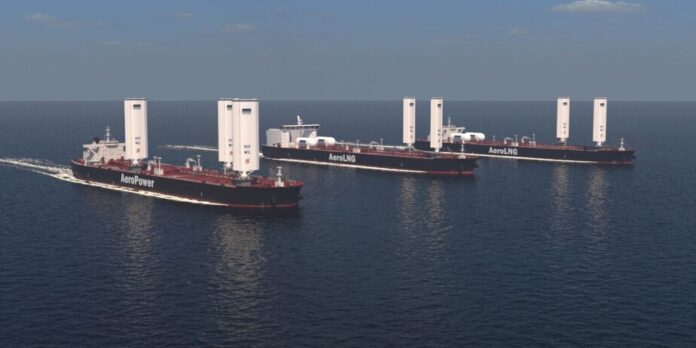
Union Maritime and BAR Technologies have secured SOLAS approval for two MR2 tankers fitted with WindWings®. The Marshall Islands Flag State Administration and Bureau Veritas granted the approvals.
The vessels are under construction at Wuhu Shipyard in China. They will use BAR Technologies’ WindWings® to cut fuel use and emissions.
The approval covers SOLAS equivalency proposals. These address bridge visibility, navigation lights, and radar line-of-sight. Wing sail installations can affect all three areas.
The decision builds on earlier approvals for LR2 tankers at Yangzijiang Shipbuilding. It also follows the successful installation on SWS Brands Hatch. Together, they confirm that WindWings® integrate safely across tanker designs.
The approvals create a clear regulatory pathway. Shipowners can now adopt wind propulsion without delays. This lowers risk and supports faster fleet-wide decarbonisation.
John Cooper, CEO of BAR Technologies, said the approval proves WindWings® meet strict safety rules and scale commercially. He added that close work with flag states and class societies accelerates decarbonisation.
Laurent Cadji, Managing Director of Union Maritime, said the MR2 project extends the company’s decarbonisation strategy across vessel types. He highlighted the balance between innovation, compliance, and performance.
Alex Gregg-Smith, President Marine & Offshore at Bureau Veritas, said the approval reflects a strong safety case and the maturity of wind propulsion technology.
Simon Bonnett, Deputy Commissioner of Maritime Affairs of the Marshall Islands, stressed the importance of aligning innovation with safe vessel operation.
The two MR2 tankers, hull numbers W23131 and W23132, will deliver between 2026 and 2027. Each WindWing® can save about 1.5 tonnes of fuel and more than 4.7 tonnes of CO₂ per day.
The approvals allow owners to act now. WindWings® deliver immediate emissions cuts without waiting for new fuel infrastructure. They also give operators flexibility as future regulations evolve.