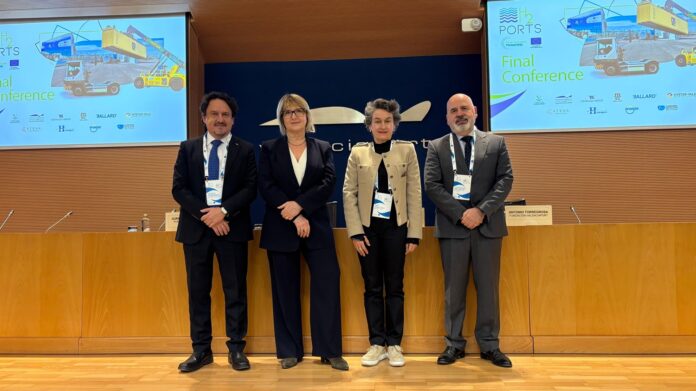
The Port of Valencia today hosted the final conference of the H2PORTS project, a pioneering initiative that has enabled the testing in real operations of a hydrogen-powered ReachStacker and a 4×4 tractor unit, as well as a mobile refueling station for this clean fuel.
The event, which brought together 30 speakers and more than 150 participants and presented the main results of this initiative, took place first in the auditorium of the Port Authority of Valencia and then at the Xità quay, where attendees were able to see the prototypes up close.
During the visit to the pilots developed as part of the project, the public was able to examine closely the hydrogen fuel cell ReachStacker prototype designed and produced by Hyster-Yale and tested in real operation at MSC Terminal Valencia.
This ReachStacker has been designed to match the performance of its diesel equivalent, both in terms of lifting capacity and operating speed. Its design combines a fuel cell with an electric traction system and independent hydraulic motors, enabling efficient energy management even in the most demanding tasks.
Equipped with four high-pressure hydrogen tanks that comply with international standards, the vehicle can operate for a full shift and even up to two on a single refill. It has also received very positive feedback from dockworkers, who highlight its performance, comfort, and a quieter, vibration-free, and emission-free driving experience.
Attendees were also able to learn in detail about the world’s first hydrogen-powered port terminal tractor unit, converted from a diesel unit. The vehicle conversion was carried out by ATENA with the support of ENEA, the Parthenope University of Naples, and Grimaldi Euromed, to be subsequently tested at Valencia Terminal Europa, part of the Grimaldi Group.
This is a prototype port vehicle with a hybrid propulsion system that combines a 70 kW fuel cell supplied by Ballard, a 25 kWh battery, and four high-pressure hydrogen tanks, allowing it to operate for a full shift without local emissions.
One of the main challenges of this pilot was developing an intelligent energy management strategy that would optimize the combined use of the hydrogen fuel cell and battery, while maintaining efficient and long-lasting performance.
These pilot tests have demonstrated that hydrogen technology can be seamlessly integrated into high-demand port operations, replacing fossil fuels without compromising efficiency, safety, or operator comfort.
Finally, participants had the opportunity to see how the hydrogen refueling station works up close.
The location of the two pilot vehicles in different port terminals necessitated a flexible solution: a mobile hydrogen refueling station.
This innovative mobile unit was custom-designed by the National Hydrogen Center and operated by Carburos Metálicos, the partner responsible for supplying renewable hydrogen for the project.
The refueling station consists of two subsystems: a fixed unit integrating the compressor and storage system, and a mobile unit equipped with high-pressure cascade tanks and a dispenser.
This solution is capable of refueling both hydrogen-powered vehicles in a single day, ensuring flexibility, operational autonomy, and high safety standards.
The station supplies hydrogen at pressures of 300 and 450 bar, with a capacity of up to 55 kg per day and a maximum dispensing speed of up to 3.6 kg per minute, enabling fast and efficient refueling, one of the main competitive advantages of hydrogen in port environments.
This mobile hydrogen station concept has proven to be technically and operationally viable, offering a scalable model for the implementation of hydrogen in other complex and highly regulated contexts, such as ports.
For Mar Chao, president of the Port Authority of Valencia, stated this project reaffirms a commitment to decarbonization and it is a cornerstone of a broader strategy to become a zero-emission port.
Valerie Bouillon-Delporte, executive director of the Clean Hydrogen Partnership, highlighted: “H2PORTS is a concrete illustration of how EU funding and cooperation can accelerate the decarbonization of critical infrastructure while it demonstrates that ports can become catalysts for clean mobility, industrial transition, and new energy value chains.
Antonio Torregrosa, managing director of Fundación Valenciaport, highlighted that they are implementing and testing different technologies that have consolidated the port as an international benchmark in sustainability, digitalization, and operational efficiency.