

The Commission’s five priorities give every port in the Hamburg-Le Havre range
identical policy language. The ports that translate shared frameworks into
differentiated stakeholder narratives will capture disproportionate competitive
positioning value.
Within a week of the European Commission publishing its EU Ports Strategy on 4 March
2026, major port associations across the continent had issued responses. Not one of
those responses distinguished one port from its competitors.
The Commission’s framework – five priorities, twenty-eight pages, a new high-level
Maritime Industries and Ports Board – gives every European port the same policy
language, the same funding instruments, and the same strategic reference points. It
treats ports as infrastructure. It does not treat them as institutions competing for
stakeholder preference.
This is where the competitive implications begin. The ports that can translate this shared
framework into a differentiated competitive narrative will extract disproportionate value
from it. The ones that cannot will have co-signed a document that primarily strengthens
their rivals’ positioning.
Same policy framework, different narrative readiness
The five priorities in the EU Ports Strategy are sound: competitiveness and digitalisation,
energy transition, security, access to finance, and skills. The Commission correctly
recognises that EU ports handle 74% of external trade, move 3.4 billion tonnes of goods
annually, and support over 423,000 direct jobs. The document calls ports
“multi-functional industrial hubs,” which they are.
But the document does not address the widening gap between ports that communicate
their strategic position effectively and those that do not. Call it the narrative gap: the
distance between a port’s operational reality and its ability to make that reality visible to
the stakeholders who allocate capital, approve permits, and route cargo.
Consider what happened in the weeks before the Strategy launched. On 26 January, the
Port of Rotterdam officially published its Vision 2050, a generational positioning
document developed with more than 100 organisations, adopted by the Rotterdam City
Council in December 2025, and presented with the outgoing Dutch Minister of Economic
Affairs standing alongside CEO Boudewijn Siemons.
The five themes of that Vision – smart and clean logistics, competitive, climate-neutral and circular industry, healthy living environment, future-proof labour market, and agile and resilient – align closely with the EU Ports Strategy’s priorities.
That alignment is not coincidental. It is the result of a communication strategy operating
at the same level as operational strategy. When the EU Ports Strategy landed five weeks
later, Rotterdam was already the reference point. One port shaped how the policy
framework was interpreted. Others responded to it.
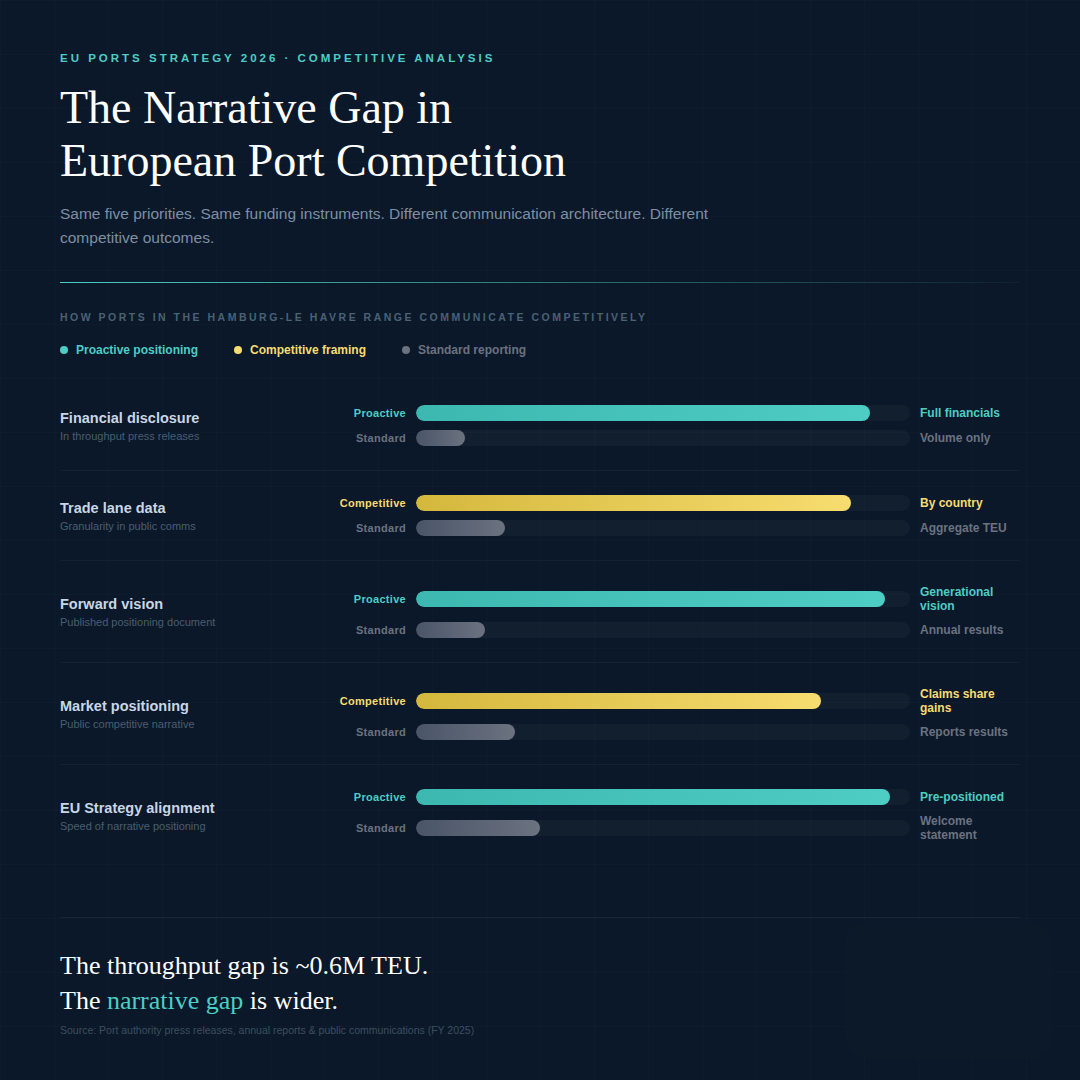
The narrative gap across the Hamburg-Le Havre range: information architecture, not data
The most common misreading of competitive positioning in this sector is that some ports
publish data and others do not. The evidence across the Hamburg-Le Havre range tells
a more specific story: the data often exists, but it is not structured to compete.
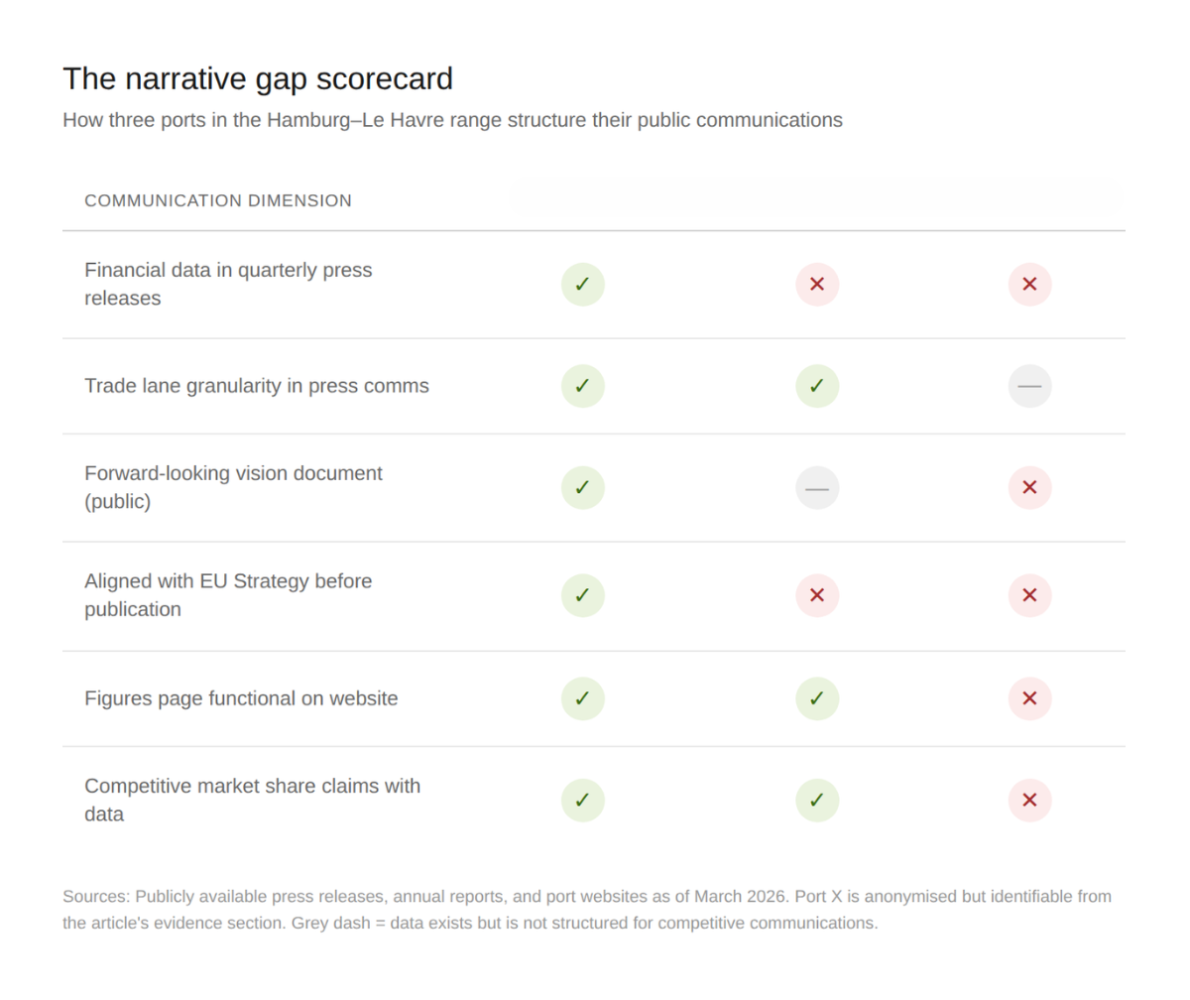
Hamburg puts country-by-country trade lane performance in its press release headlines:
China up 6.5%, India up 49.2%, Malaysia up 84.3% for full-year 2025, according to
Hafen Hamburg Marketing’s annual results. When Axel Mattern, CEO of Port of
Hamburg Marketing, stated during the H1 2025 results that Hamburg was “setting an
extremely positive example” compared to rival ports and gaining market share, the
granular data in those same communications supported the claim. The data was not just
available. It was positioned for a competitive narrative.
Rotterdam publishes port authority revenue (€940.4 million in 2025), EBITDA (€583.6
million), net profit (€266 million), and capital investment (€291.4 million) in every
throughput press release, according to the Port of Rotterdam Authority’s 2025 annual
results. Every journalist, analyst, policymaker, and industrial investor who reads a
Rotterdam quarterly update receives a financial health signal alongside the cargo
numbers.
Other ports in the range report throughput comprehensively but do not include financial
metrics in their press communications. The structural reasons vary. A corporatised entity
with national government co-ownership operates under different transparency
expectations than a public law company owned by municipal shareholders. Governance
models, disclosure obligations, and shareholder structures differ markedly across the
range. But the competitive effect is the same regardless of the cause. When one port
quantifies its institutional strength, and another describes it in qualitative terms,
stakeholders default to the quantified story.
This is where the nuance matters. Port of Antwerp-Bruges, Europe’s second-largest
container port and home to the continent’s largest integrated petrochemical cluster,
generating €21 billion in annual added value across 164,000 direct and indirect jobs, according to the port authority’s 2025 annual results, publishes comprehensive trade
area container breakdowns by region in its annual Statistical Yearbook. Europe, Africa,
North America, Latin America, the Middle East, the Far East: the data is detailed,
current, and downloadable.
But across the range, the pattern repeats: granular competitive data often lives in annual
publications rather than in the quarterly press communications and landing pages where
analysts and journalists look first. The data exists. The question is whether it reaches the
stakeholders making routing and investment decisions at the moment those decisions
are being shaped.
This is not a question of organisational capability. Antwerp-Bruges demonstrated
precisely the kind of strategic communication that drives competitive positioning when
CEO Jacques Vandermeiren addressed the European Industry Summit in February 2026
with a direct call for EU industrial policy action. The port’s Inbound Release Platform,
developed by the port authority and its subsidiary NxtPort in collaboration with The Way
Forward and Belgian Customs, and processing 219,000 unloading messages in October
2025, is among the most advanced digital customs platforms in any European port. The
2022 merger of the Port of Antwerp and Port of Zeebrugge was itself an exercise in
institutional transformation that few port authorities in Europe have attempted, let alone
completed.
The gap is not between capability and incapability. It is between institutional strength and
the routine information architecture that makes that strength visible to every stakeholder,
every quarter, through the channels where capital allocation and routing decisions are
actually shaped.
Why the EU Ports Strategy accelerates the communication gap
Every government affairs team in the Hamburg-Le Havre range has carefully read the
EU Ports Strategy. They have responded to its regulatory implications, engaged with the
Commission’s consultation, and mapped its funding instruments. That is their job, and
they have done it.
But reading a policy document and mining it for competitive narrative are two distinct
organisational functions. The ports extracting positioning value from the Strategy – the
ones that had their forward-looking vision aligned with the Commission’s priorities before
the document was published – are not doing it from the government affairs department.
They are doing it because their communications function has a seat at the strategy table,
not merely a brief after decisions are made.
That organisational pattern becomes more consequential now. Each priority in the EU
Ports Strategy creates stakeholder decision points: funding allocations, permitting
approvals, foreign ownership guidance, and industrial partnerships. At each point,
policymakers, investors, and industrial partners will compare ports against one another.
The ports with communication infrastructure to frame their value for each audience will
be first into those conversations. The ports without it will discover that strong operations
are necessary but not sufficient.
The throughput data from 2025 illustrates the stakes. The container volume gap
between Europe’s two largest container ports narrowed from approximately 3 million
TEU in 2019 to fewer than 300,000 TEU in 2024, before widening again to roughly
600,000 TEU in 2025 as Antwerp-Bruges contended with terminal congestion and
industrial action while Rotterdam’s container volumes grew faster. The trajectory is not
linear, but the direction over five years is clear: market positions across the Hamburg-Le
Havre range that appeared settled are now contested. Hamburg posted full-year
container growth of 7.3%, driven by surging Asian trade lanes. HAROPA Port surpassed
three million TEU for the second consecutive year since recovering to that level.
In this environment, operational performance alone does not determine competitive
outcomes. Hamburg’s growth narrative, Rotterdam’s institutional credibility narrative, and
HAROPA’s momentum narrative are not merely reflections of throughput performance.
They are strategic instruments deployed to influence the next round of shipping line
routing decisions, carrier terminal investments, and policymaker capital allocations.
No amount of narrative can fix a capacity constraint or resolve a labour dispute. But the
ports gaining competitive ground right now are not just operationally strong. They are
communicationally organised. Their narrative gap is small. Their competitors’ is not.
The positioning window is open, and it will not stay open
The EU Ports Strategy creates a positioning window. Over the next twelve to eighteen
months, every major European port will align its strategy documents, funding
applications, and stakeholder communications with the Commission’s five priorities. The
ports that do this first and most specifically – not merely echoing the Strategy’s language
but connecting it to verifiable, regularly published competitive data – will anchor their
position with the stakeholders who matter most.
Strong individual positioning does not weaken the European port system. It strengthens
each port’s ability to contribute to it. But for port authorities whose operational substance
exceeds their public narrative – and there are several in the range whose assets, trade
volumes, and industrial ecosystems deserve more visible positioning – the strategic
question is no longer whether to invest in communication infrastructure. It is how quickly
that investment can close the gap before competitors make it permanent.
This article was written by Rasha Hamdan, a brand and marketing strategist specialising in competitive positioning for complex enterprise and industrial organisations across European
markets.
Source attribution: All data points attributed inline to named sources (Port of
Rotterdam Authority 2025 annual results, Hafen Hamburg Marketing annual results, Port
of Antwerp-Bruges 2025 annual results, EU Ports Strategy document of 4 March 2026,
Port of Antwerp-Bruges newsroom).
Disclosure: The author has no commercial relationship with any port authority
referenced in this article.