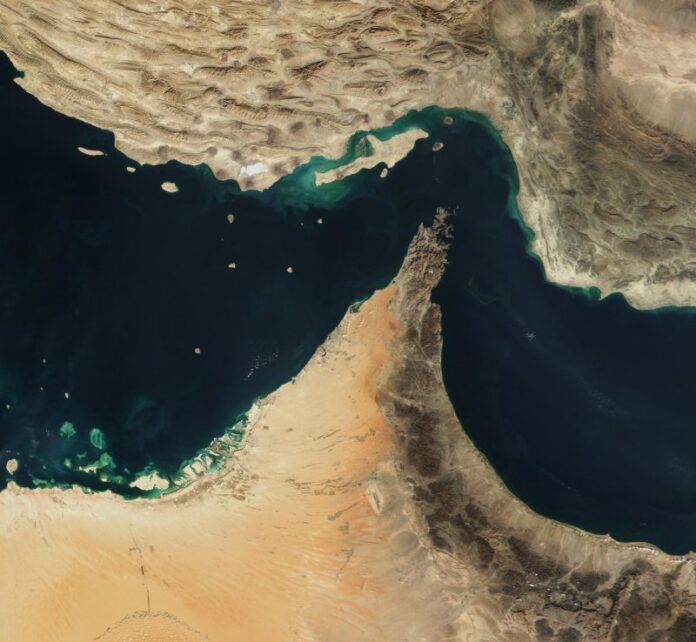
To calculate this potentially trapped capacity, Sea‑Intelligence utilised carriers’ published schedules and applied it to two scenarios. Under the ‘Baseline Scenario’, which assumes all deployed vessels operated with strict adherence to their published schedules with zero delays, a minimum of 156,074 TEU of deep‑sea capacity is potentially restricted.

However, when applying historical vessel delay buffers to reflect realistic operational conditions, the restricted capacity under this ‘Adjusted Scenario’ increases significantly to 204,159 TEU. The delta between these two scenarios indicates that an additional 48,085 TEU is potentially trapped, simply due to vessels running behind schedule. This demonstrates how existing network inefficiencies can directly compound the severity of geopolitical disruptions.
A sustained closure also triggers immediate secondary spillover effects across the broader deep‑sea network. Vessels currently enroute to the Persian Gulf will be forced to abort their rotations, leading to sudden cargo displacement at alternate transshipment hubs outside the chokepoint e.g., Salalah, Colombo, and Singapore. This sudden diversion will inevitably cause yard density to spike, degrading terminal productivity and creating berthing delays for mainline vessels on completely unrelated trade lanes.
Furthermore, because the Persian Gulf is structurally a net‑import region, these deep‑sea services typically load empty containers to reposition back to Asian manufacturing hubs. Trapping over 200,000 TEU of capacity simultaneously starves Asian export hubs of vital equipment, potentially causing container shortages in the Far East.