

Sea-Intelligence has published issue 173 of the Global Liner Performance (GLP) report, with schedule reliability figures up to and including December 2025.
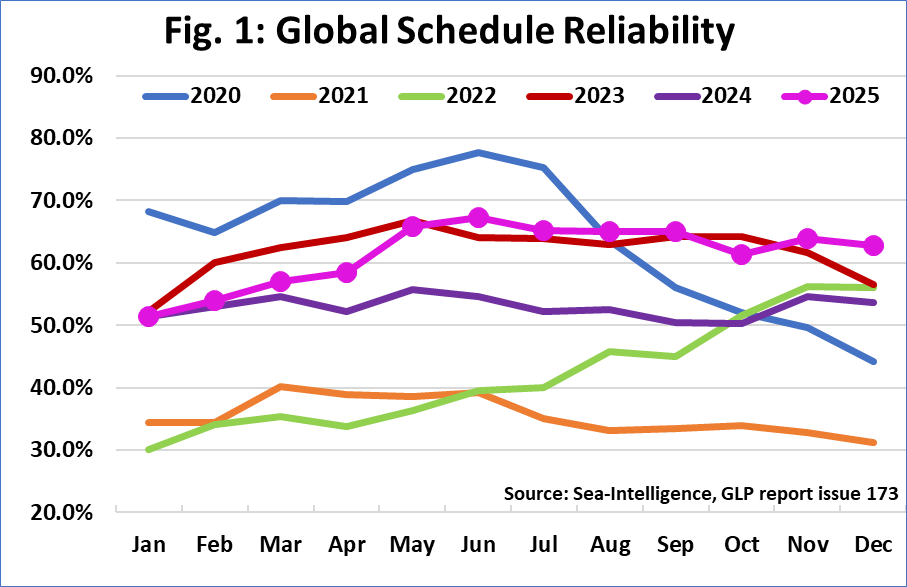
In December 2025, global industry schedule reliability dropped by -1.2 percentage points M/M to 62.8%, the second-lowest monthly figure since May. On a Y/Y level, schedule reliability was up 9.0 percentage points. The average delay for LATE vessel arrivals also deteriorated, increasing M/M by 0.04 days to 5.04 days. This is the second-highest figure since April. On a Y/Y level, the December 2025 figure was -0.29 days lower.
Maersk was the most reliable top-13 carrier in December 2025 with schedule reliability of 76.7%, followed by Hapag-Lloyd with 75.2%. MSC and HMM were in the 60-70% range, while eight of the remaining nine carriers were in the 50-60% range. Wan Hai was the least reliable carrier with schedule reliability of 47.8%. Only four carriers recorded a M/M improvement, while all 13 carriers recorded a Y/Y improvement in schedule reliability.
In November/December 2025, Gemini Cooperation recorded 92.3% schedule reliability across ALL arrivals and 90.8% across TRADE arrivals, followed by MSC at 73.5% for ALL arrivals and 71.9% for TRADE arrivals. Premier Alliance recorded 56.9% for ALL arrivals and 56.6% across TRADE arrivals. For the “old” alliances, “ALL arrivals” remain equal to “TRADE arrivals,” and Ocean Alliance scored 58.8%.
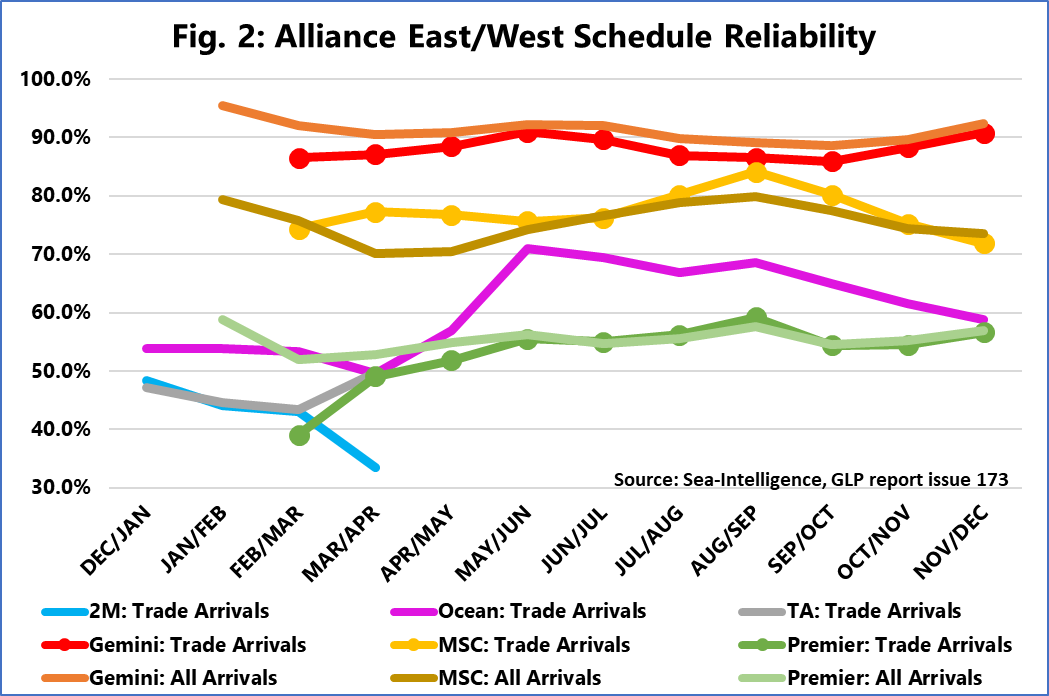
Traditionally, alliance scores are based on just the arrivals in destination regions, but as that metric was not available for the new alliances in February, Sea-Intelligence introduced a new measure, based on all arrivals, including the origin region calls on the East/West trades. Sea-Intelligence continues to present both measures, “All arrivals” which is comparable to the February measure, and “Trade arrivals”, which is comparable to the “old” alliances. When the new alliances are fully rolled out, these two measures will converge.