The Port of Rotterdam Authority has completed a market consultation aimed at understanding why investment decisions for hydrogen carrier import terminals remain stalled, despite multiple companies having advanced plans in place.
The findings reveal a convergence of financial and non-financial risks that are deterring firms from committing capital at this stage.
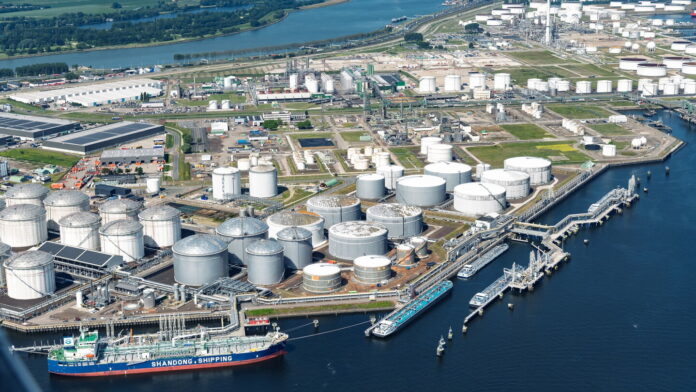
At least nine companies are currently developing plans for terminals capable of handling ammonia, methanol, liquid hydrogen or liquid organic hydrogen carriers, with some concepts incorporating on-site conversion facilities such as ammonia cracking or LOHC dehydrogenation plants.
Given that the cost of such a terminal can run to several hundred million euros, investors are seeking a degree of certainty over their ability to recover that investment before proceeding.
Demand uncertainty emerged as the primary obstacle. Companies cited a lack of clarity around the implementation of policies designed to stimulate end-user demand for renewable energy carriers as a central concern, making it difficult to underwrite long-term investment cases.
Alongside this, permitting uncertainty, particularly regarding nitrogen deposition regulations and unpredictable procedural timelines, was identified as a significant barrier.
Power grid congestion and the absence of adequate pipeline infrastructure connecting Rotterdam to its hinterland, most notably the delayed Delta Rhine Corridor linking the port to Germany, were also flagged as material constraints.
The combined effect of these factors has pushed most companies’ projected operational timelines beyond 2030.
The Port of Rotterdam Authority has indicated it is working with public and private partners to prioritise and address the risks identified through the consultation, with the aim of unblocking investment and accelerating the development of hydrogen import infrastructure at the port.