
In our latest poll, Container News asked readers what they believe will have the biggest impact on container shipping profitability in 2026. The responses across our platforms point to a clear concern shaping expectations for the year ahead.
Key Insights
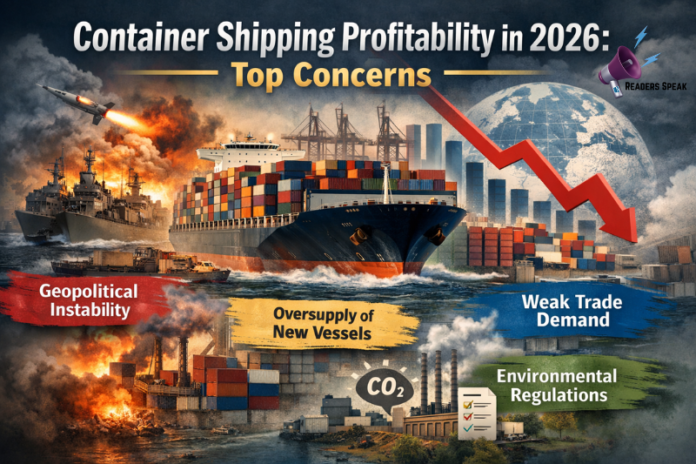
According to our readers, continued geopolitical instability stands out as the dominant factor likely to affect container shipping profitability in 2026.
Ongoing tensions in critical regions such as the Red Sea, the Black Sea, and the Taiwan Strait remain a major source of uncertainty for carriers, influencing routing decisions, insurance costs, capacity deployment, and overall operational risk.
Beyond geopolitics, newbuild vessel oversupply emerged as another significant concern. With a large number of new container ships scheduled for delivery, readers highlighted the risk of excess capacity placing pressure on freight rates and carrier margins, particularly if demand fails to keep pace.
Weak global trade demand was also seen as a meaningful headwind. Sluggish economic growth, cautious consumer spending and uneven recovery across regions continue to cloud the outlook for cargo volumes. This reinforces concerns about profitability in an already competitive market.
Interestingly, environmental regulations, including ETS, FuelEU Maritime and CII, were viewed as having a comparatively limited direct impact on shipping profitability in 2026.
While regulatory compliance remains important, readers appear to see these measures as a more manageable or longer-term challenge compared with immediate geopolitical and market-driven risks.
Looking Ahead
The poll results suggest that container shipping executives and market participants are entering 2026 with a strong focus on risk management and uncertainty, rather than regulation alone.
Geopolitical tensions, combined with fleet growth and fragile demand, are expected to play a decisive role in shaping profitability across the sector.
As the industry moves forward, the ability to adapt to shifting trade routes, manage capacity effectively and respond to external shocks will be critical in determining financial performance in the year ahead.