After nearly two years of costly diversions, Maersk eyes a December comeback through the world’s most strategic waterway but security questions loom larger than savings.
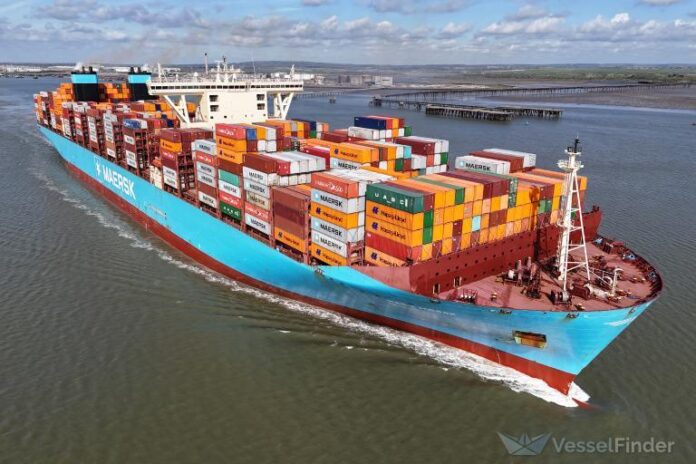
Maersk’s tentative plan to resume Suez Canal transits marks a critical inflection point for global shipping, but the carrier’s careful hedging reveals how thoroughly the Red Sea crisis has shattered confidence in maritime chokepoint reliability.
The world’s second-largest container line announced a strategic partnership with Egypt’s Suez Canal Authority last week, with officials initially declaring vessels would return “in early December.”
Yet Maersk quickly clarified it had set no firm timeline, saying sailings would restart only when security conditions fully support crew safety.
That disconnect between Cairo’s optimism and Copenhagen’s caution captures the delicate calculus facing an industry watching for signs that 13 months of Houthi attacks have genuinely subsided.
Container News proceed to the generation of some potential scenarios on under which conditions Maersk could start its return to Suez Canal:
Scenario 1: Tactical Stabilization with Fragile Foundations
Maersk proceeds with gradual Suez transits starting December-January but maintains Cape route optionality.
Key drivers: Houthi force preservation amid US-UK military pressure; regional diplomatic fatigue; economic pressures on Yemen requiring Saudi-Omani corridor openness; carrier financial calculations favoring partial normalization.
Shipping implications: Mixed routing strategies become the norm. Maersk and CMA CGM test waters with select services while maintaining Cape infrastructure. Freight rates compress moderately but stabilize above pre-crisis levels due to persistent insurance premiums and hedging costs. Industry excess capacity tightens as dual-routing absorbs available tonnage.
Scenario 2: Renewed Disruption Cycle
Initial return attempts succeed for 6-8 weeks before renewed attacks force another Cape rerouting.
Key drivers: Iran signals opposition to regional normalization through proxy escalation while Gaza conflict intensification provides justification for renewed maritime campaign as internal Houthi political dynamics favor hardline factions.
Shipping implications: Carriers face worst-case scenario capital deployed for Suez normalization becomes stranded when forced back to Cape routing. Contract negotiations paralyzed by uncertainty. Accelerated investment in alternative corridors (IMEC, North-South) as industry abandons Red Sea reliability assumptions. Freight rate volatility exceeds 2021 crisis levels.
Scenario 3: Negotiated Corridor Framework
Maersk’s return reflects undisclosed understandings brokered through Omani-Saudi mediation involving partial Houthi recognition, humanitarian corridor guarantees, or economic incentives to Yemen.
Key drivers: Regional power brokers prioritize economic stability over ideological purity; Houthi leadership recognizes maritime revenue potential and broader Yemen conflict de-escalation creates political space for pragmatic arrangements.
Shipping implications: Suez corridor stabilizes but operates under fundamentally transformed risk profile. Insurance markets develop specialized Red Sea products with implicit geopolitical guarantees. Major carriers dominate route access through negotiated frameworks, disadvantaging smaller operators.
Scenario 4: Strategic Repositioning Window
Regional stabilization proves durable due to broader Middle East realignment potential normalization breakthroughs, definitive Gaza resolution, or Iranian strategic recalibration prioritizing economic engagement over confrontation.
Suez returns to near-normal operations by Q2 2025.
Key drivers: Major diplomatic breakthrough complete Houthi integration into Yemen governance structure neutralizing maritime campaign motivations.
Shipping implications: Rapid capacity reallocation from Cape routing creates temporary overcapacity shock. Freight rates collapse 40-60% below current levels as Asia-Europe route efficiency returns. However, permanent structural changes persist and alternative corridor development continues.
The broader question transcends tactical routing decisions: whether maritime chokepoints function as neutral commercial infrastructure or weaponized geopolitical leverage.
Maersk’s cautious approach acknowledges that even successful near-term transit restoration cannot erase the crisis’s fundamental lesson that critical trade corridors remain hostage to regional conflicts thousands of miles from cargo origins and destinations.