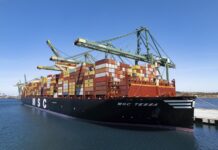
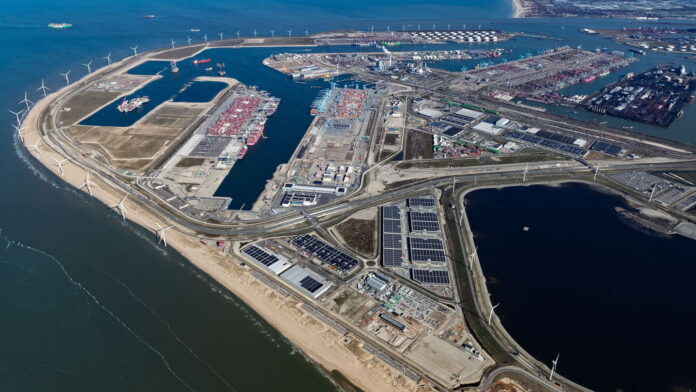
The European Investment Bank has agreed to lend EUR€90 million to the Port of Rotterdam Authority to finance the installation of shore power facilities at three deep-sea container terminals.
The funding will support Rotterdam Shore Power, a joint venture between the Port of Rotterdam Authority and Eneco established to deliver the infrastructure programme.
The project encompasses shore power installation across eight kilometres of quay, providing 35 connection points for seagoing container vessels. Beyond the onshore power supply units themselves, Rotterdam Shore Power’s scope includes the grid connection, cabling and associated construction and excavation works required to bring the system into operation.
The installations are expected to be delivered and commissioned in phases from the second half of 2028.
Alongside the EIB loan, the project has been approved for a European Commission grant of approximately EUR€70 million under the Alternative Fuels Infrastructure Facility of the Connecting Europe Facility, bringing the total public financing package to around EUR€160 million.
Shore power enables vessels berthed at the terminal to shut down their auxiliary engines and connect to the local electricity grid, eliminating the emissions, noise and air quality impacts associated with running engines in port.
For Rotterdam, the investment represents a significant step in reducing fossil fuel dependency at Europe’s largest container port.
EIB Vice-President Robert de Groot highlighted the broader strategic dimension of the initiative, framing energy independence and reduced reliance on imported fuels as objectives that align environmental and geopolitical imperatives.
Cecilia Thorfinn, acting head of the European Commission Representation in the Netherlands, reinforced this framing, describing the Connecting Europe Facility support as part of a wider effort to deploy alternative fuel infrastructure across European transport networks.