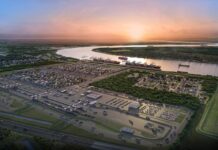


The Port of Los Angeles closed calendar year 2025 with total container throughput of 10,239,318.40 TEUs, reinforcing its position as the busiest port in the United States despite a modest year-over-year decline.
Compared with 2024, when the Port handled 10,297,352 TEUs, overall volume in 2025 declined by 58,033.6 TEUs, representing a 0.56% decrease year over year. Even with that slight dip, throughput remained well above pre-recovery levels and far exceeded 2023’s total of 8,629,681 TEUs.
On a longer-term basis, the rebound is significant. Total container volume rose 19.33% from 2023 to 2024, while 2025 volumes were still 18.65% higher than 2023, underscoring the Port’s sustained recovery and operational resilience.
Import Volumes Edge Lower in 2025
Loaded import containers totaled 5,316,713.30 TEUs in 2025, down from 5,356,680.15 TEUs in 2024. That represents a decline of 39,966.85 TEUs, or a 0.75% year-over-year decrease.
Port officials attributed the marginal softening in imports to shifting consumer demand patterns and ongoing adjustments in global supply chains, rather than structural weakness in port operations.
Export Volumes Decline Slightly Year Over Year
Loaded export containers totaled 1,429,260.00 TEUs in 2025, compared with 1,494,201.30 TEUs in 2024. This reflects a decrease of 64,941.30 TEUs, or a 4.35% year-over-year decline.
Despite the reduction, export volumes remained historically consistent, reflecting stable outbound trade flows amid changing global market conditions and transportation dynamics.
Leadership Highlights at the 2026 State of the Port
At the 2026 State of the Port of Los Angeles, Executive Director Eugene D. Seroka emphasized both the scale of the achievement and the collaborative effort behind it.
“The Port handled 10.2 million container units in 2025, the third best year in the Port’s 118-year history and the third time exceeding 10 million TEUs,” Seroka said. “That success, and our 26th consecutive year as the nation’s busiest port, reflects the hard work of the entire Port community and our many stakeholders.” he said.
Looking ahead, Seroka stressed the importance of innovation and infrastructure modernization under the Port’s “Build Smarter” strategy.
“Building smarter means continuing to invest in proven technology,” he said, citing tools such as the Port Optimizer™, Signal, and the Universal Truck Appointment System as critical to improving cargo velocity, transparency, and efficiency across the supply chain.