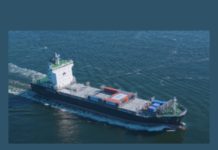
Increased containership sizes and the growth of container shipping overall have combined to change the pattern of operational challenges in seagoing transport. While greater scale continues to make economic sense, it also exposes more containers to open deck conditions, requires higher stacks, and calls for greater resilience in the face of excessive vessel roll motions.
Where traditional approaches to container ship safety are based on long-term metocean statistics, they may not always adequately reflect conditions on a given voyage, particularly when assessing roll-induced accelerations and lashing loads.
To help the container shipping sector maintain a robust understanding of real-world stowage and voyage conditions, ClassNK recently prepared a suite of new guidelines that offer an integrated, data-driven approach to containership safety. They combine short-voyage weather forecasting, direct load analysis, and roll-reduction technologies in a coherent framework.
According to ClassNK, the new guidelines offer operators, designers, and cargo planners a basis for taking a more dynamic view of vessel behavior to support safer, more transparent decision-making – also enabling more rational use of loading capacity when conditions permit.
Predictive Metocean Data in Stowage Decisions
A centerpiece for the new framework is the Guidelines for the Safety of Maritime Cargo Based on Weather Forecasts. This document develops short-voyage assessments from long-term scatter diagrams as real-time deterministic forecasts. By focusing on voyages of 72 hours or less, the guidelines allow operators to base stowage decisions on forecasted wave heights, wind conditions, and associated uncertainties, rather than static statistical envelopes that diverge from near-term expectations along a planned route.
ClassNK’s methodology quantifies forecast uncertainty by treating metocean parameters, particularly significant wave height, as probability distributions. This enables the calculation of short-term voyage loads representing a 25-year return period, adjusted to reflect forecasted weather without underestimating risk. These corrected loads can then feed directly into hull response predictions and lashing strength assessments.
The guidelines go further. Annex A introduces a sea route correction factor that ties the maximum forecasted significant wave height to roll angle, pitch angle, and acceleration adjustments. This allows planners to apply weather-sensitive correction factors to container securing calculations, providing a more rational basis for determining allowable stack weights and arrangements. By aligning stowage planning with forecast-based load modelling, the guidelines offer a path to optimized loading on routes where conditions allow, while strengthening safety margins in more severe scenarios.
Technical Framework for Reducing Roll
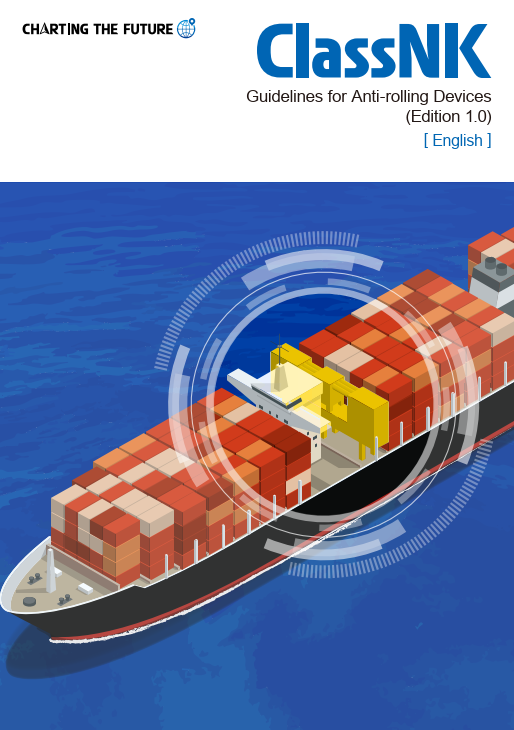
Alongside weather forecast guidelines, ClassNK has issued the first edition of its Guidelines for Anti-Rolling Devices, recognizing the increasing adoption of anti-rolling tanks and stabilizers on large container carriers. Historically used on passenger and research vessels, anti-rolling technologies are now gaining prominence on large container carriers, reflecting a growing concern about incidents considered to have been caused by excessive roll and parametric roll.
The new guidelines formalize the technical, operational, and survey requirements for such systems. They define the class notation “Anti-Rolling Device” (ARD) and outline expectations for power stability, environmental resistance, control integration, and emergency operation, including the need for manual isolation or drainage of anti-rolling tanks in abnormal situations.
Annex A introduces a comprehensive procedure for evaluating roll-reduction effects through non-linear direct load analysis. This includes modelling ship response in irregular waves, accounting for loading conditions with the largest and smallest metacentric heights (GM) and assessing the impact of tank dynamics across multiple sea states and headings. In practice, it allows operators of ARD-equipped ships to demonstrate quantified roll reduction, which can be reflected in container stowage and securing evaluations.
Connected Approach to Containership Safety
These initiatives form part of a broader body of work by ClassNK to produce an integrated safety framework that links environmental prediction, hull response, cargo securing, and motion-control technologies.
The guidelines reference and reinforce ClassNK’s Guidelines for Container Stowage and Securing Arrangements, ensuring that weather-derived load factors and ARD reduction coefficients are fully compatible with existing structural and lashing assessment methodologies. By creating this interoperability, ClassNK is enabling a more vessel specific and data rich approach to cargo securing, and one that accounts for actual route conditions, real-time weather intelligence, and ship-specific motion characteristics.
The implications for operators are manifold. Weather-based load assessments offer the potential for more confident decision-making and better use of vessel capacity on short voyage legs. Anti-rolling devices provide a measurable contribution to reducing roll-induced hazards. The combined framework strengthens the industry’s ability to manage motion and load risks on today’s large container carriers and intensive service patterns.
These latest guidelines represent a significant step towards a technical and operational toolkit that responds directly to emerging safety and operational challenges while enabling the industry to pursue efficiency and reliability.