Australia’s newest and largest intermodal terminal has started rail freight services, marking a major step for Victorian and national supply chains.
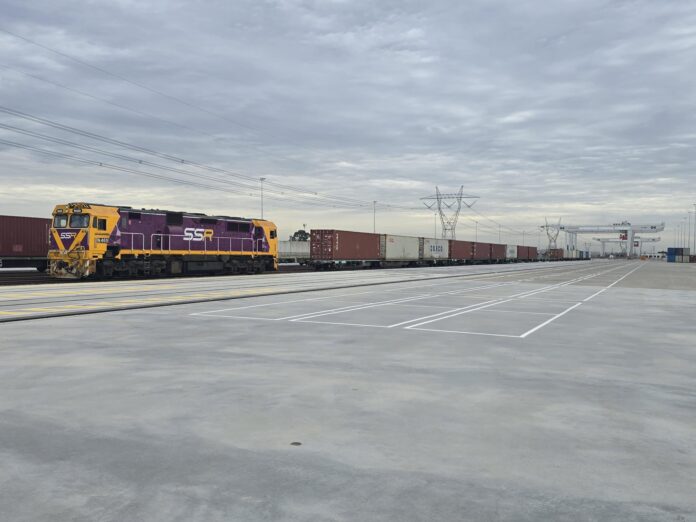
The $400 million Melbourne Intermodal Terminal (MIT), backed by Aware Super, commenced freight train operations in November. The terminal sits at the Somerton logistics precinct in Melbourne’s north.
Intermodal Terminal Company (ITC) designed, built and now operates the facility. The MIT forms a key part of the broader $1.6 billion Melbourne Intermodal & Industrial Exchange (MIIX), developed by Aware Real Estate and Barings.
The Port of Melbourne has selected the MIT as a central hub in a new incentive scheme aimed at shifting container freight from road to rail. The initiative, developed with the Victorian Government and industry, operates under the Port Rail Shuttle Network Start-up Incentive Program.
The program supports import container volumes during the terminal’s ramp-up phase. It also encourages early adoption of rail services now that the MIT is operational. Current proposals include incentives of $100 per TEU and $200 per FEU for import containers moved by rail from the port to the MIT.
ITC said the scheme makes rail a more cost-effective option for importers while easing pressure on congested roads and tolled motorways around inner Melbourne. Rail freight also reduces traffic accidents, road damage and vehicle emissions across the transport network.
The shift comes as transport is forecast to become Australia’s largest source of greenhouse gas emissions by 2030. Rail haulage offers an immediate option to help meet emissions reduction targets.
Since construction finished in mid-November, ITC has ramped up operations. The terminal is expected to move more than 1,000 containers between the MIT and the port by Christmas. Initial volumes include 40-foot containers loaded with timber logs for export to Asia.
Logs arrive at Somerton by truck from regional Victoria. The MIT then loads the cargo into containers and moves them by rail to the port using the ARTC standard-gauge network. The process avoids inner-city congestion and toll roads.
Southern Shorthaul Railroad (SSR) operates the port shuttle services. Current trains measure around 600 metres and carry about 80 TEUs per trip. Following strong early demand, ITC and SSR plan to increase train lengths from 2026.
ITC said rail allows heavier containers to move directly into port terminals safely and efficiently. This removes the need for road transport and improves overall supply chain efficiency.
The MIT sits about 20 kilometres by rail from the Port of Melbourne. It connects directly to the Hume Freeway and both Victorian and interstate rail networks. Around 20 per cent of Victoria’s containerised freight and 3.5 million square metres of warehousing sit within close proximity.
The terminal operates as a one-stop logistics hub. Services include customs-bonded storage, empty container processing and recycling, and on-site washing, fumigation and repair facilities.
At full development, the MIT will handle up to one million TEUs annually. Plans allocate around 650,000 TEUs for interstate freight and 350,000 TEUs for port shuttle services.
The facility also features fully electric, 350-tonne rail-mounted gantry cranes. The cranes can regenerate electricity back into the grid during lifting and loading operations.