
Inmarsat Maritime, a ViaSat company, announced the next phase of its NexusWave bonded connectivity service. This follows the successful launch of the ViaSat-3 Flight 2 satellite and anticipates the launch of Flight 3.
The two ViaSat-3 satellites will enter service in 2026. NexusWave customers will gain significantly more bandwidth. A new maritime terminal, the VS60, will support the upgrade. VS3 Flight 2 will cover the Americas, and VS3 Flight 3 will cover Asia-Pacific. Customers investing in NexusWave today will get faster speeds, higher performance, and improved flexibility.
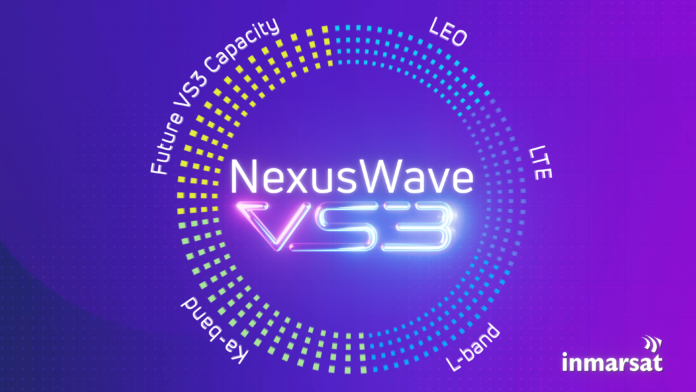
NexusWave is a fully managed, bonded multi-network service. It combines GEO Ka-band, LEO, LTE, and L-band networks into one intelligent connectivity solution. The ViaSat-3 satellites deliver faster data transfer and better network efficiency. They support digitalisation and crew welfare, offering “office-like” and “home-like” internet at sea.
The new VS60 maritime terminal, built by Intellian and powered by ViaSat software-defined radio technology, strengthens the NexusWave network. It supports high-bandwidth applications, including enterprise networking, video streaming, crew welfare, and mission-critical operations. In sea trials, the VS60 achieved download speeds above 250 Mbps. It also includes multiple security layers to protect sensitive data.
ViaSat-3 satellites have over 1,000 steerable spot beams. They dynamically move bandwidth to match demand across shipping lanes, ports, and offshore locations.
Gert-Jan Panken, Vice President of Inmarsat Maritime, said: “NexusWave’s multi-orbit architecture and the VS60 terminal enable us to support global fleet priorities. This ensures reliability, security, and excellent customer experience. Fleets can also scale as network capacity grows.”
Ben Palmer OBE, President of ViaSat Commercial, added: “NexusWave delivers consistent performance in a complex connectivity environment. ViaSat-3 gives more bandwidth, flexibility, and a clear upgrade path. Fleets can stay confidently connected into the future.”