Incat Tasmania has marked a major milestone in maritime history after successfully powering up the world’s largest battery-electric ship and completing its first electric motor trial in Hobart, Tasmania, on 14 December 2025.
The vessel, known as Hull 096, is the largest battery-electric ship ever constructed and the largest electric vehicle of any kind globally. Measuring 130 metres in length, it is designed to carry 2,100 passengers and more than 220 vehicles.
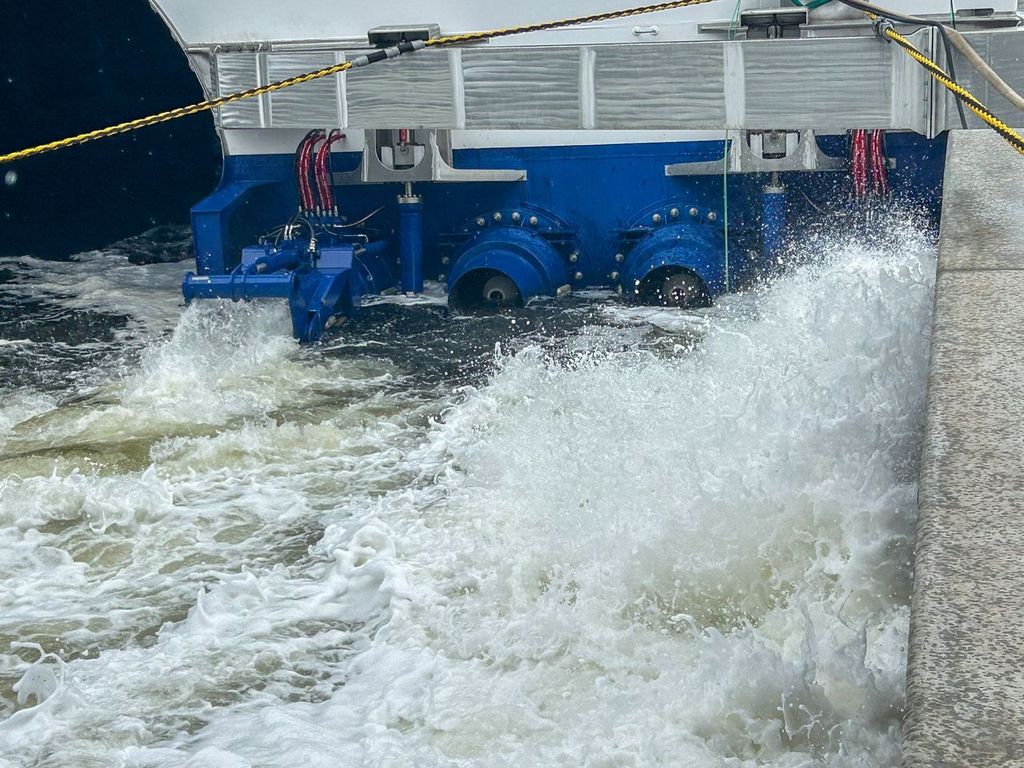
Moreover, the power-up represented the first activation of the largest battery-electric propulsion system ever installed on a ship. During the trial, the vessel operated entirely on battery power, demonstrating propulsion capability at a scale never previously achieved in the maritime sector.
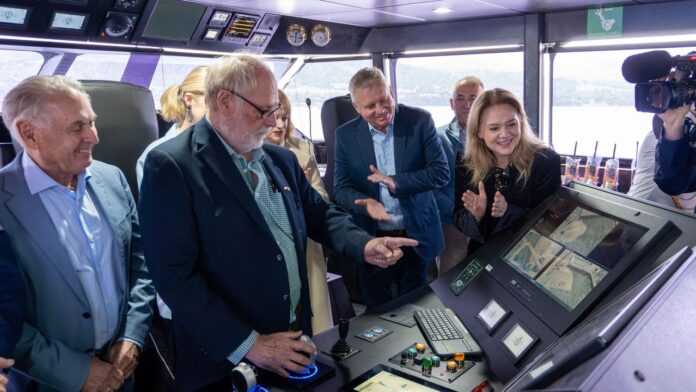
The event was witnessed by invited dignitaries, including Australian Trade Minister Don Farrell, Tasmanian Premier Jeremy Rockliff, and Barbara Baker, Governor of Tasmania.
Incat Chairman Robert Clifford led the demonstration, powering up the vessel’s waterjets and showcasing the performance of the electric propulsion system.
The trial marked the first time a ship of this size, weight and passenger-vehicle capacity has operated solely on battery power anywhere in the world.
Furthermore, designed and built in Hobart, the vessel highlights a significant advance in large-scale electric shipbuilding and reinforces Tasmania’s role in the global transition toward sustainable maritime technologies.
Additionally, the ship is powered by an energy storage system comprising more than 250 tonnes of batteries, delivering over 40 megawatt-hours of installed capacity. According to Incat, this is four times larger than any previous battery installation used in maritime applications.
“This is the first time a ship of this size, anywhere in the world, has been trialled under 100% battery-electric propulsion,” said Robert Clifford, Chairman, Incat. “It’s a remarkable achievement by our workforce and a turning point for shipbuilding.”
“Tasmania has been at the forefront of international aluminium shipbuilding for decades, and today’s milestone shows we are now leading the world in the next era — sustainable, high-performance vessels at scale,” he added.
Clifford said the project demonstrates the strength of Australian innovation and advanced manufacturing. “We are proving that advanced manufacturing in Australia is not only alive, but setting global benchmarks. This ship stands as a flagship for what’s possible when industry, design and clean-energy technology come together.”
Beyond this, the successful trial positions Incat and Tasmania at the forefront of next-generation, zero-emission vessel development, as the global maritime industry accelerates efforts to reduce carbon emissions and adopt cleaner propulsion technologies.