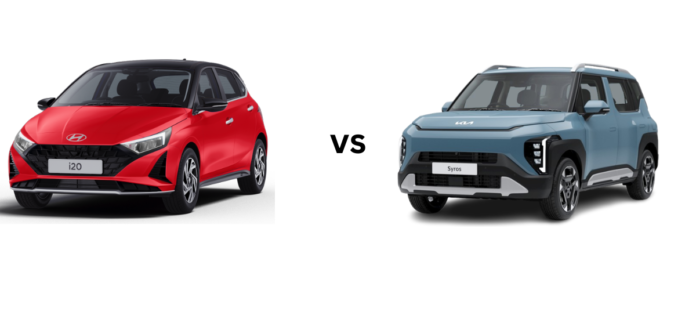
The modern car buyer is increasingly faced with a choice that goes beyond price and features: should a vehicle prioritise agility or presence? The comparison between the Hyundai i20 and the Kia Syros captures this dilemma effectively. While one is engineered for nimble urban driving, the other is designed to offer a commanding stance and an elevated driving experience.
This trade-off reflects a broader shift in automotive preferences, where how a car feels on the road can be as important as what it offers on paper.
Agility: The Strength of Low-Slung Design
The Hyundai i20 is built around the principles of agility and control. Its compact dimensions (3,995 mm length, 2,580 mm wheelbase) and low centre of gravity make it particularly well-suited for urban driving.
This translates into:
- Quick directional changes
- Better cornering stability
- Ease of navigation in tight city spaces
Its 1.2L petrol engine delivering up to 88 PS, combined with manual and IVT transmission options, ensures smooth, predictable performance.
The i20’s design reinforces this focus. The i20’s sporty stance, aerodynamic lines, and responsive handling all contribute to an engaging driving experience.
For drivers who value control and precision, these characteristics are essential.
Commanding Presence: The SUV Advantage
The Kia Syros, in contrast, is designed to offer a commanding presence on the road. Its upright stance, higher ground clearance, and squared proportions create a sense of authority that is immediately noticeable.
It is an SUV “reimagined for the future,” with bold design and a strong road presence.
Key design elements include:
- High bonnet and upright seating position
- Boxy silhouette for a robust appearance
- Distinctive LED lighting and SUV-inspired styling
These features give the Syros an advantage in visual and physical presence.
Driving Position: Low vs Elevated Perspective
One of the most noticeable differences between the two vehicles is the driving position.
The i20 offers a lower seating position, which enhances connection with the road and improves handling dynamics. This setup is ideal for drivers who prefer a more engaging and controlled driving experience.
The Syros, on the other hand, provides a higher seating position, offering:
- Better visibility of the road ahead
- Increased sense of control
- Easier navigation in traffic
This elevated perspective is one of the primary reasons buyers are drawn to SUVs.
Handling vs Confidence
Agility and presence also influence how a car feels to drive.
The i20’s compact size and lightweight structure allow it to feel responsive and easy to control. Its handling characteristics are particularly beneficial in:
- Congested city conditions
- Narrow roads
- Frequent stop-and-go traffic
The Syros, while less agile, compensates with a sense of confidence. Its larger dimensions and higher stance make it feel more stable in varied conditions, particularly on highways and uneven roads.
This difference reflects two driving philosophies:
- i20 = precision and responsiveness
- Syros = confidence and control
Interior Experience: Driver-Centric vs Space-Oriented
Inside the cabin, the contrast continues.
The i20 offers a driver-focused interior, featuring:
- Digital cluster with TFT display
- Compact yet well-organised layout
- Dual-tone interiors with ambient lighting
The emphasis is on creating an engaging driving environment.
The Syros, however, focuses on space and comfort. Its interior includes:
- Wide panoramic display and modern dashboard
- Sliding and reclining rear seats
- Larger cabin for improved passenger comfort
This makes it more suitable for both passengers and the driver.
Technology: Everyday Convenience vs Advanced Systems
Both vehicles incorporate modern technology, but their scope differs.
The i20 offers:
- 10.25-inch infotainment system with Bluelink connectivity
- Voice recognition and OTA updates
- Wireless connectivity features
These features enhance daily usability.
The Syros expands on this with:
- Connected car navigation cockpit
- ADAS features for driver assistance
- 360-degree camera and advanced monitoring systems
This aligns with its positioning as a more feature-rich SUV.
Safety: Standard vs Enhanced Assistance
Safety systems further highlight the difference in approach.
The i20 includes 6 airbags, ESC, VSM, and other standard safety features, ensuring a strong baseline of protection.
The Syros builds on this with:
- ADAS features for proactive safety
- Advanced driver assistance and monitoring systems
This creates a more comprehensive safety ecosystem.
Buyer Perspective: Agility or Presence?
The choice between the i20 and Syros ultimately depends on what the buyer values more:
- Buyers prioritising driving dynamics, compact size, and efficiency are likely to prefer the Hyundai i20
- Buyers seeking road presence, visibility, and versatility may lean toward the Kia Syros
This decision reflects a shift in how buyers evaluate vehicles.
The Role of Digital Platforms
Online car-buying platforms such as ACKO Drive allow buyers to compare vehicles across categories, highlighting differences in driving position, features, and usability.
This helps users determine whether agility or presence aligns better with their needs.
Conclusion
The Hyundai i20 and Kia Syros represent two distinct approaches to mobility—agility and commanding presence. While the i20 excels at delivering a responsive, engaging driving experience, the Syros offers confidence and visibility through its SUV design.
As the market continues to evolve, this trade-off is becoming increasingly central to car buying decisions, reflecting a broader shift toward experience-driven choices.