Japanese shipping giant doubles down on alternative routes as US-China tariffs reshape global commerce.
As US-China trade tensions simmer toward another boiling point, Japanese shipping giant K-Line is making a calculated wager that could redefine its position in global maritime trade.
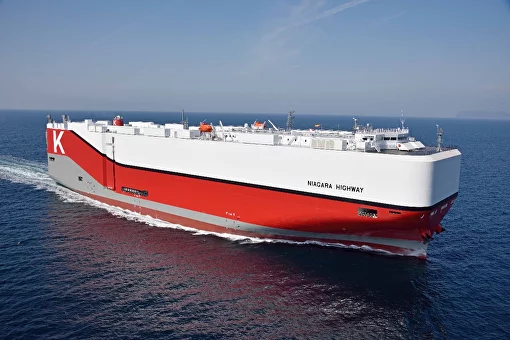
The company’s announcement that it stands ready to divert container ships away from US routes represents more than tactical maneuvering it signals a fundamental recalibration of global shipping networks.
CEO Takenori Igarashi had confirmed the company is “closely watching” tariff negotiations, prepared to pivot vessels toward Europe, the Middle East, Australia, and Africa if trade barriers escalate. But K-Line isn’t simply reacting to geopolitical headwinds.
The company has dramatically increased capital expenditures from 520 billion to 740 billion yen, positioning itself to capitalize on what it sees as permanent shifts in trade geography.
While competitors hesitate, K-Line is investing aggressively in what it calls “strategic moves in downturns.” The centerpiece: expanding its LNG carrier fleet from 46 to 65 vessels by fiscal 2026.
These aren’t speculative investments, they’re backed by long-term charters with energy giants like QatarEnergy, providing revenue stability as container markets fluctuate.
The timing proves deliberate. As Europe diversifies away from Russian gas and Asian economies prioritize energy security, K-Line’s LNG expansion captures growing demand across multiple regions. The company has effectively insulated itself from container market volatility by anchoring revenues in sectors governments consider strategically critical.
Beyond traditional shipping, K-Line is staking claim to emerging infrastructure that governments increasingly view as strategic: carbon capture and storage transport. Joint ventures in Alaska mark the first CCS feasibility study between Japanese firms and the US, while agreements for Norway’s Havstjerne project position K-Line at the center of European industrial decarbonization.
As carbon pricing regimes expand and border adjustment mechanisms take hold, the ability to transport and inject CO2 efficiently becomes valuable infrastructure with high barriers to entry for latecomers.
The company is simultaneously developing alternative propulsion technologies, including the Seawing automated kite system and ammonia-fueled vessels.
These innovations, supported by Japanese government subsidies, reduce exposure to fossil fuel price volatility while meeting tightening environmental regulations that carry increasingly geopolitical dimensions.
K-Line’s restructuring of its logistics subsidiary reveals understanding of a deeper shift.
As companies pursue nearshoring and supply chain diversification, demand grows for integrated maritime-to-inland solutions rather than simple point-to-point shipping. The establishment of a holding company with Kamigumi and deployment of advanced yard management systems position K-Line to serve increasingly complex logistics networks.
Also, K-Line’s integrated capabilities become competitive advantages as supply chains fragment.
Research on maritime networks shows that even as specific routes face disruption, overall network structures prove resilient through hub reconfiguration. K-Line’s emphasis on alternative regional hubs Middle Eastern ports, Australian terminals, African gateways positions the company to benefit as trade corridors multiply.
Crucially, Asia remains the gravitational center of global trade despite decoupling rhetoric.
China’s fastest-growing trade relationships span the Global South, reinforcing rather than weakening Asian maritime dominance. K-Line’s pivot toward intra-Asian and Asia-Africa-Europe corridors captures this structural reality.
The company’s positioning holds whether tariffs escalate or ease. If trade barriers rise, K-Line’s diversified fleet reduces concentration risk while competitors struggle with excess transpacific capacity.
If tensions cool, investments in growth markets position K-Line to capture rebound demand first.