
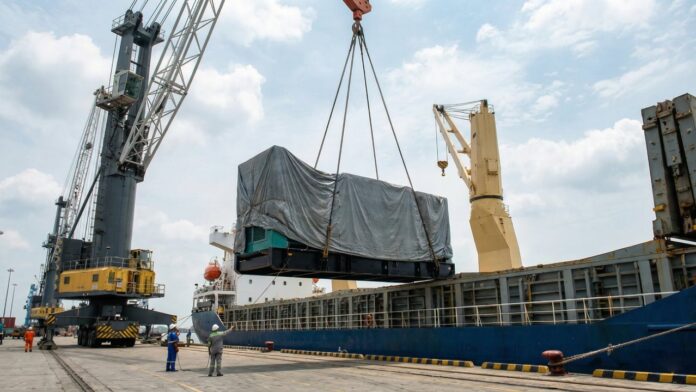
Heavy Equipment Shipping Overseas: Containers, RoRo, or Breakbulk?
Moving a standard pallet of goods across the Atlantic is a predictable equation. Moving a 30-ton Caterpillar excavator, a mining dump truck, or a tower crane is an entirely different discipline. Heavy equipment transportation demands precision, engineering knowledge, and a deep understanding of maritime logistics.
For project managers and logistics directors involved in transactions on marketplaces for buying and selling heavy machinery, the decision narrows down to three primary methodologies: Roll-on/Roll-off (RoRo), Containerization (including Flat Racks), and Breakbulk.
This guide dissects the operational realities of these three methods to help you determine the optimal strategy for your cargo.
Global Heavy Machinery Logistics in 2026
The demand for cross-border machinery transport is surging. With the global construction equipment market projected to exceed $289 billion by 2030 (“Heavy Construction Equipment Market (2024 – 2030)”, Grand View Research), the pressure on logistics networks to deliver oversized cargo efficiently has never been higher.
However, maritime shipping faces volatility. Fluctuating bunker fuel prices and port congestion impact how carriers prioritize cargo. While standard TEUs (Twenty-foot Equivalent Units) get automated handling, heavy machinery requires manual intervention.
Choosing the wrong method does not merely result in a higher freight bill. It causes project delays, customs hold-ups, and potential damage to high-value assets.
Method 1: Roll-on/Roll-off – Industry Standard
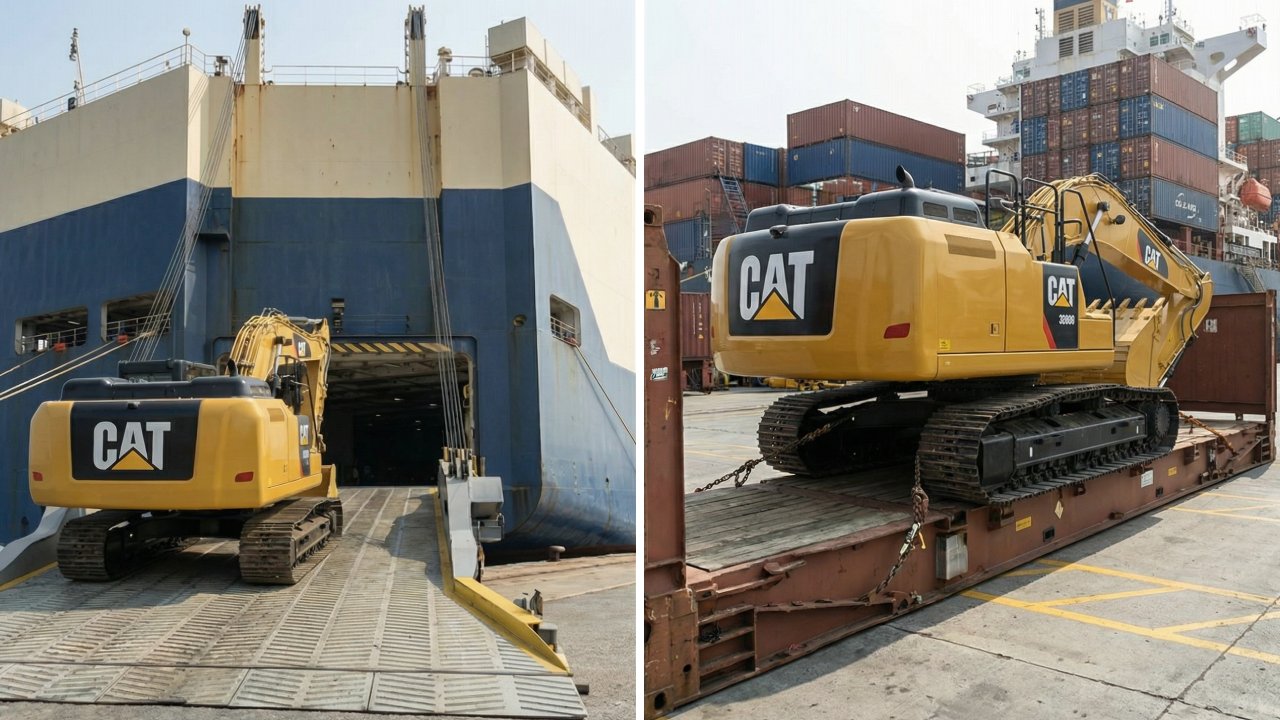
Operational Edge
RoRo is arguably the safest and most cost-effective method for heavy equipment shipping when the cargo has wheels or tracks. Because the unit is not lifted by a crane, the risk of handling damage drops significantly.
- Simplicity: The machine drives on at the port of origin and drives off at the destination.
- Protection: Cargo is stowed below deck, protected from wind, salt spray, and water elements.
- Cost efficiency: Carriers charge based on the volume (length x width x height) rather than weight (up to a certain limit), making it cheaper than specialized container options for large units.
Non-Runner Factor
RoRo is not exclusive to operational vehicles. Static cargo or non-runners (machines with mechanical issues) can still ship via RoRo using MAFI trailers — heavy-duty dollies that port tractors tow onto the vessel.
Best Use Cases
- Excavators and bulldozers
- Agricultural tractors and combines
- Mining dump trucks
- Road pavers and graders
Major RoRo carriers operate strictly on specific trade routes. If your destination is a smaller, remote port, RoRo might require transshipment, which complicates the logistics.
Method 2: Container Shipping – Dismantle to Save
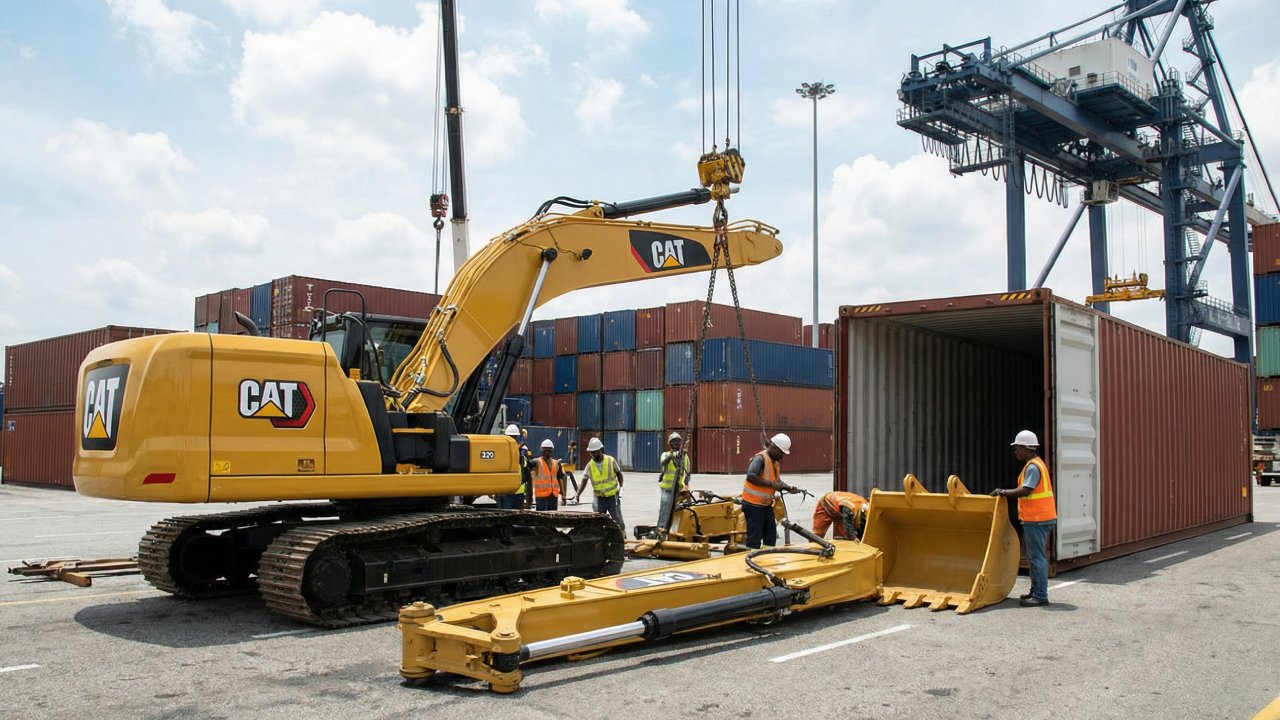
Standard Containers (20ft & 40ft)
If a machine can be dismantled, shipping it inside a standard 40ft High Cube container is one of the cheapest options available. Freight rates for standard containers are generally lower than RoRo rates per cubic meter.
Trade-off: You trade freight savings for labor costs. You must pay certified mechanics to dismantle the boom, arm, bucket, and cab, pack them securely, and then reassemble them upon arrival.
Special Equipment: Flat Racks and Open Tops
For equipment that is too wide or too tall for a standard box but not massive enough for Breakbulk, Flat Racks are the solution.
- Flat racks: Essentially a container floor with sturdy ends but no walls or roof. Ideal for out-of-gauge cargo.
- Open tops: Containers with a removable tarpaulin roof, allowing overhead crane loading.
Strategic Advantage
Containers offer route flexibility. Container ships call at virtually every commercial port in the world. If you need to ship a mid-sized wheel loader to a remote port in West Africa or a specific terminal in Southeast Asia, a container vessel will likely get it there faster than a RoRo vessel waiting for a full load.
Method 3: Breakbulk – When Size Knows No Bounds
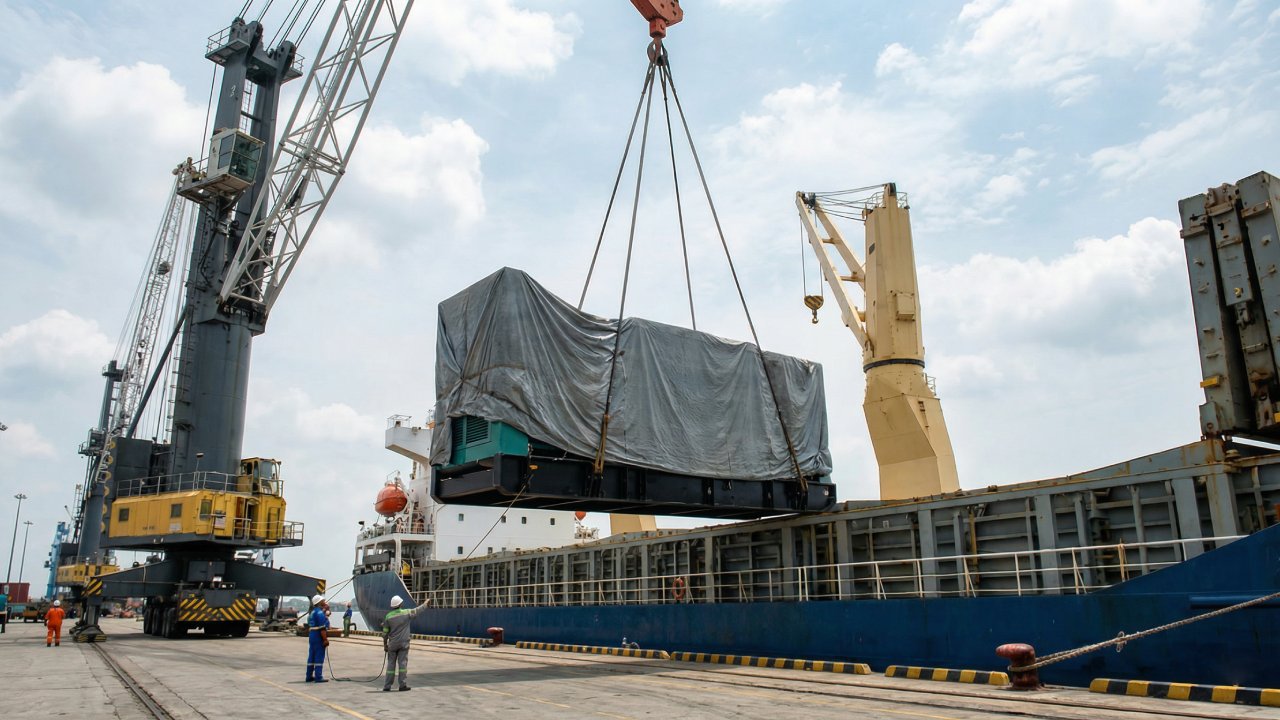
Complexity of Lift-on/Lift-off
Breakbulk requires specialized stevedoring. The cargo must have designated lifting points, and the center of gravity must be precisely calculated, which is why operators handling oversized project cargo are typically involved in executing these shipments.
- High capacity: Ideal for static, oversized equipment like generators, turbine blades, or massive industrial presses.
- Chartering flexibility: Breakbulk involves chartering part of a vessel or utilizing multi-purpose vessels equipped with heavy-lift cranes (gear).
Cost Implications
Breakbulk is generally the most expensive option. Charges are calculated based on freight tons (the greater of weight or volume), and surcharges apply for heavy lifts (usually over 20-30 metric tons). Furthermore, port handling charges for Breakbulk are significantly higher than for RoRo or containers.
Comparative Analysis: Decision Matrix
To make an informed decision, compare the operational realities of each method.
| Feature | RoRo | Container (Flat Rack/Standard) | Breakbulk |
| Primary cargo | Wheeled/tracked vehicles | Dismantlable or mid-sized units | Oversized, static, heavy |
| Cost | Moderate | Low (standard) to high (out-of-gauge) | High |
| Handling risk | Low (minimal lifting) | Moderate (dismantling risks) | High (crane operations) |
| Global coverage | Major ports only | Universal coverage | Route specific |
| Transit speed | Slower / less frequent | Fast / frequent sailings | Variable / inducement calls |
| Prep work | Wash & clean | Dismantle & pack | Lifting plans & crating |
Hidden Costs and Biosecurity
Freight rates are only one component of the total landed cost. Heavy equipment transportation involves ancillary fees that can ambush an unprepared budget.
Biosecurity and Cleaning
Strict environmental regulations, particularly in Australia (DAFF), New Zealand (MPI), and the United States, mandate that used machinery be free of soil, seeds, and organic matter.
- RoRo: Requires rigorous steam cleaning before delivery to the terminal. If a RoRo unit fails inspection at the destination, it may be re-exported or destroyed.
- Containers: Easier to control. A sealed container is less likely to be contaminated during transit, though the machine inside must still be spotless.
Marine Cargo Insurance
Carrier liability is famously limited (capped by the Hague-Visby Rules). Relying on the shipping line’s standard coverage is a gamble. For high-value machinery, All-Risk insurance is mandatory. Note that insurance premiums for Breakbulk are typically higher than RoRo due to the increased handling risks.
Last-Mile Delivery
A 40-ton dump truck might fit on a RoRo vessel, but can it legally travel on the highway from the port to your job site?
- Permits: Heavy haulage often requires police escorts and special road permits.
- Trailer height: A Flat Rack might arrive at the port, but you need a low-boy trailer to transport it inland to avoid hitting overpasses.
Strategic Recommendations for Shippers
Selecting the right mode depends on the intersection of three vectors: budget, deadline, and technical feasibility.
1. Drivable Rule
If the machine runs and fits within standard RoRo height limits (usually around 5 to 6 meters, depending on the vessel class), RoRo is almost always the superior choice. It balances cost with safety.
2. Remote Site Exception
If shipping to a location with poor infrastructure or no RoRo terminal, Flat Racks or Containers become the default. The cost of dismantling is preferable to the cost of transshipping a RoRo unit via a barge or driving it hundreds of miles overland.
3. Volume
If shipping multiple units (e.g., six excavators), stacking them on Flat Racks or dismantling them into 40ft containers might yield a bulk discount that RoRo cannot match.
4. Consult with Experts
Logistics for heavy iron is not a DIY task. Utilizing a specialized freight forwarder ensures that you have access to the latest sailing schedules and competitive contract rates. They can assess whether a specific carrier accepts used machinery or if a specific port has the crane capacity to lift your 50-ton Breakbulk piece.
Wrapping Up: Heavy Equipment Shipping in 2026
The global supply chain is a mechanism of moving parts, and nowhere is that more literal than in heavy machinery logistics.
While RoRo offers the path of least resistance for wheeled cargo, containerization rewards those willing to invest in mechanical labor to secure lower freight rates. Breakbulk remains the titan for the impossible loads, serving a niche where engineering triumphs over standardization.
Analyze your cargo’s dimensions, evaluate the destination’s infrastructure, and calculate the total landed cost — including dismantling, cleaning, and insurance. By aligning the shipping method with the specific needs of your equipment, you ensure that your heavy machinery arrives ready to work, protecting both your assets and your bottom line.