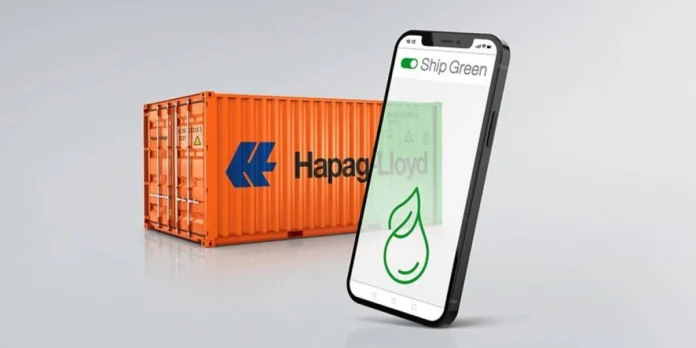
Hapag-Lloyd and DSV have expanded their decarbonization partnership with a two-year Ship Green framework agreement covering 18,000 tonnes of CO₂e emission reductions.
The agreement, starting in 2026, focuses on Scope 3 greenhouse gas reductions generated through the use of sustainable marine fuels in Hapag-Lloyd’s fleet. The reductions are calculated on a well-to-wake basis.
Under the deal, DSV will purchase verified emission reductions primarily from second-generation biofuels produced from waste- and residue-based feedstocks. The framework also allows the inclusion of other sustainable fuel types, making it the first agreement of its kind for both companies.
The partnership builds on cooperation launched in 2022, when the two companies began working together on sustainable marine biofuels.
Hapag-Lloyd said the agreement demonstrates how carriers and forwarders can jointly scale lower-emission shipping solutions. DSV described sustainable marine fuels as a tangible and scalable pathway to reduce supply chain emissions.
The agreement operates under a book-and-claim mechanism. This allows DSV and its customers to claim verified emission reductions regardless of where the fuel is physically used. Only emissions savings from biofuel already consumed within Hapag-Lloyd’s owned and operated fleet will be allocated under the deal.
Hapag-Lloyd targets net-zero fleet operations by 2045. DSV has committed to achieving net-zero emissions across its operations and value chain by 2050. Biofuels currently represent the most available and scalable decarbonization option in ocean freight, according to both companies.