

A landmark dataset and two years of Red Sea crisis have exposed a fundamental shift in how Beijing deploys port power no longer along routes, but across a self-reinforcing global network.
This content is locked
Select a CN Premium Subscription Package To Unlock The Content!
That composure is the clearest evidence yet of a structural transformation in Chinese maritime strategy a shift from what analysts now describe as a directional model, defined by point-to-point investments along fixed trade corridors, to a dimensional one: an integrated, redundant, and self-reinforcing global maritime system.
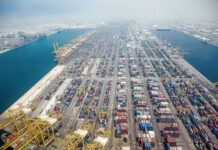
A new dataset released last week by AidData, the research lab at William & Mary University, provides the most granular account yet of China’s global port footprint. Between 2000 and 2025, Chinese state entities committed nearly $24 billion in loans and grants for 168 ports across 90 countries.
Chinese port financing is split almost evenly between high-income nations Greece, Australia, Singapore, Spain and low-to-middle income countries across Africa, South Asia, and Latin America.
This is not the debt-trap playbook of popular imagination, which assumed Beijing targeted only financially vulnerable states. It is something more sophisticated: a dual-layer architecture in which wealthy terminal investments generate commercial revenue and political legitimacy, while developing-world ports provide logistical depth, resource proximity, and strategic access.
AidData’s researchers also documented 22 Chinese-financed mines located within 500 kilometers of Chinese-funded seaports a pattern visible at Peru’s Port of Chancay, adjacent to the Las Bambas copper mine, and Guinea’s Port of Morébaya, developed alongside the Simandou iron project.
The port, in this construction, is no longer simply a trade node. It is a logistics anchor for an integrated supply chain that stretches from extraction to export, financed and controlled at every link.
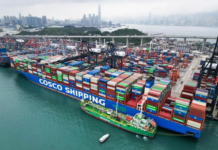
The Houthi campaign against commercial shipping served, inadvertently, as a live stress test for this system and Beijing passed it. China held a 20 percent stake in Egypt’s Port Said and a 25% share in Ain Sokhna, the latter acquired in March 2023 just months before the crisis erupted. Both terminals absorbed revenue losses as Suez Canal transits collapsed by nearly half.
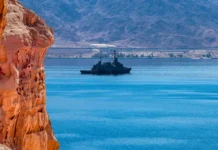
Yet Chinese carriers, granted quiet passage by Houthi commanders, largely continued through the corridor while Western competitors rerouted around the Cape of Good Hope.
The rerouting itself validated a separate layer of the Chinese network. West African terminals, including the ΘΣ$1.5 billion Lekki Deep Sea Port in Nigeria financed by China Development Bank and completed in 2023 absorbed diverted cargo volumes. Chinese naval assets at Djibouti monitored the operational environment.
The system did not break. It redistributed.
The physical network is reinforced by a digital layer that Western analysts have been slow to interrogate. At least 24 ports worldwide have adopted Logink, China’s state-owned logistics platform, which provides Beijing access to cargo manifests, pricing data, and movement intelligence including, analysts warn, military equipment shipments.
The AidData update also captured Chinese-financed shoreside equipment, including cranes and security scanners, extending Chinese technological presence deep into host-nation supply chains in ways that transcend ownership stakes.
The strategic implication is now difficult to dispute.
China is not building a port network to facilitate global trade. It is constructing a parallel maritime order one structurally capable of sustaining Chinese commerce, energy imports, and military logistics even under conditions of Western-imposed sanctions, blockade, or chokepoint interdiction.
The Panama crisis in which CK Hutchison’s concession over canal-flanking ports was voided under US pressure demonstrated that Western governments have begun to understand the stakes.
But the countermeasures remain reactive. The US International Development Finance Corporation has committed modest sums to alternative port projects; the EU has tightened foreign investment screening. Neither approaches the scale or coherence of what Beijing has assembled over two decades.
The implication runs deeper than the statistic. What was once a strategy of securing corridors has become the construction of a system one that, by design, has no single point of failure.
The Red Sea did not expose a vulnerability in China’s maritime position. It confirmed the completion of something far more consequential.