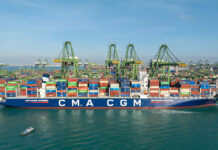


The US operation in Caracas over the weekend, which facilitated the US military’s capture of Venezuela’s President Maduro, included strikes on the city’s La Guaira container port and a nearby military base.
La Guaira is Venezuela’s second largest container port, and tits closure will disrupt operations and cause delays for importers and exporters who normally rely on La Guaira. Even before the US action, there were reports of some tranship volumes shifting awayfrom Venezuela due to the growing instability. But the larger Port of Cabello is only about 60 miles to the west, and as Venezuela overall is a small market for container trade – with handling capacity of around a million TEU per year – impacts from the strike on La Guaira are unlikely to be felt beyond Venezuela.
In trade war developments, the US delayed its planned January 1st tariff increase on lumber products including furniture, for one year. The Department of Commerce also stepped back from plans for a sharp tariff hike on Italian pasta imports. These deescalations may partially be motivated by cost of living concerns that are putting some pressure on the White House. These responses add more uncertainty as to how the administration – whose stated intention is to quickly reinstate tariffs by other means – may react if the Supreme Court decision invalidates its IEEPA-based, country-specific tariffs introduced last year.
In ocean freight, start of year GRIs pushed Asia – Europe rates up 9% to the $3,000/FEU mark last week, and Asia – Mediterranean prices up more than 20% to $4,800/FEU, reflecting 23% and 45% climbs since mid-December, respectively.
These hikes – pushing Mediterranean rates even with their peak season 2025 high and Europe prices to their highest since late August – reflect growing pre-Lunar New Year demand on these lanes, even as carriers add capacity to service these volumes. These rate levels are well above long term pre-LNY norms, but even with Red Sea diversions continuing and volumes likely stronger than last year, Asia – Europe prices remain 40% lower than last year, likely an effect of a growing fleet.
Transpacific container rates, which started climbing in mid-December, continued their ascent last week via January 1st GRIs. Prices to the West Coast increased 22% to $2,617/FEU, and are more than 30% higher than in mid-December. East Coast rates climbed 12% to $3,757/FEU and are up 20% in less than a month.
That prices haven’t retreated at all from December increases – like they had following several GRI attempts in Q4 – suggests that LNY demand is picking up and supporting prices on these lanes too. Even if demand has started to pick up, volumes are projected to be 10% lower than last year, likely contributing, along with capacity growth, to significantly lower year on year rate levels for these lanes.
In air cargo, ex-China rates eased to $6.18/kg to the US and $3.44/kg to Europe – down from peak season highs of $8.00/kg and $4.00/kg – as post-peak demand slows. Prices out of South East Asia are likewise cooling, with rates to the US down to $4.28/kg last week from a mid-December high of $5.80/kg, and prices to Europe sliding to $2.90/kg from a peak of $4.00/kg.