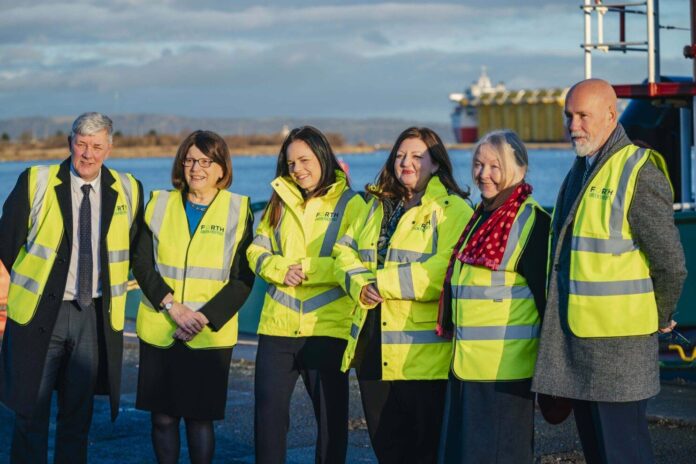
Pictured: On the quayside at the Port of Leith: Cllr Altany Craik, Fife Council; Dame Susan Rice DBE, Chair of the Forth Green Freeport, Kate Forbes, Deputy First Minister; Kirsty McNeill, Parliamentary Under Secretary of State for Scotland; Cllr Jane Meagher, City of Edinburgh Council; Cllr Allan Nimmo, Falkirk Council
The Forth Green Freeport (FGF) has today (15 January 2026) marked a joint agreement which unlocks £25 million of seed funding from the UK Government to support reindustrialisation of the Edinburgh, Fife and Falkirk areas and attract £7.9 billion of private and public investment over the next decade.
At the Port of Leith, Parliamentary Under Secretary of State for Scotland, Kirsty McNeill and Deputy First Minister, Kate Forbes joined the Forth Green Freeport Chair, Dame Susan Rice DBE, and CEO, Sarah Murray, and representatives from the three local authorities – Cllr Altany Craik, Fife Council; Cllr Allan Nimmo, Falkirk Council; and Cllr Jane Meagher, City of Edinburgh Council – to mark the signing of a Memorandum of Understanding (MoU) with the UK and Scottish Governments, which releases £25 million of seed capital funding. This seed capital will be match funded by project leads bringing an initial investment in the area to more than £50million.
The seed capital funding will help prepare the key sites within the FGF area to attract investors and deliver major economic benefits for Scotland. It will mean delivery can begin on projects*, which have been identified to attract major inward investment in the key target sectors including offshore wind, hydrogen, sustainable fuels, modular manufacturing and logistics, FGF will support the re-industrialisation and large-scale economic regeneration of Central Scotland over the next decade.
FGF became operational on 12 June 2024 and over the next 25 years is set to attract new businesses and new jobs into Burntisland, Grangemouth, Leith and Rosyth, aided by a suite of tax and custom incentives to del
The Forth Green Freeport has marked a joint agreement which unlocks US$33.4 million of seed funding from the UK Government to support reindustrialization of the Edinburgh, Fife, and Falkirk areas and attract US$10.5 billion of private and public investment over the next decade.
At the Port of Leith, Parliamentary Under Secretary of State for Scotland joined the Forth Green Freeport Chair to mark the signing of a Memorandum of Understanding with the UK and Scottish Governments, which releases US$33.4 million of seed capital funding.
This seed capital will be match funded by project leads bringing an initial investment in the area to more than US$66.9 million.
The seed capital funding will help prepare the key sites within the FGF area to attract investors and deliver major economic benefits for Scotland.
It will mean delivery can begin on projects which have been identified to attract major inward investment in the key target sectors including offshore wind, hydrogen, sustainable fuels, modular manufacturing, and logistics. FGF will support the reindustrialization and large-scale economic regeneration of Central Scotland over the next decade.
A detailed economic impact assessment has projected that FGF will generate US$10.5 billion of private and public investment and boost gross value added by US$10.8 billion.
The analysis projected that up to 34,500 well-paid, skilled jobs could be created with around 16,000 of these being direct employment in the FGF’s target sectors and tax sites.
The event took place at the Port of Leith which has been transformed through major private investment by owners and FGF Consortium partner, Forth Ports, into a world class renewables hub which is currently hosting the Inch Cape Offshore Wind project marshalling the foundation component parts of the 72-turbine wind farm being constructed off the Angus coast.
This website uses cookies so that we can provide you with the best user experience possible. Cookie information is stored in your browser and performs functions such as recognising you when you return to our website and helping our team to understand which sections of the website you find most interesting and useful.
Strictly Necessary Cookies
Strictly Necessary Cookie should be enabled at all times so that we can save your preferences for cookie settings.
If you disable this cookie, we will not be able to save your preferences. This means that every time you visit this website you will need to enable or disable cookies again.