

Taiwanese liner operator Evergreen Marine Corporation (EMC) is forking out over TW$99 billion (US$3.2 billion) on newbuildings and equipment.
Fourteen 14,000 TEU LNG dual-fuelled ships have been commissioned, the orders equally split between South Korea’s Samsung Heavy Industries and China’s Guangzhou Shipyard International.
EMC’s filing to the Taiwan Stock Exchange on 12 November stated that the newbuildings, to be delivered between 2028 and 2029, cost between US$2.45 billion and US$2.87 billion.
The newbuildings mean that EMC, the seventh-largest liner operator, now has 56 ships of 856,223 TEU under construction, amounting to 44% of its existing fleet of 1.94 million TEU, including owned tonnage of 1.33 million TEU.
EMC has also ordered 90,500 new containers from four manufacturers. From Guangdong Fuwa Engineering Group, 31,150 containers costing US$92.59 million; Dong Fang International Container (Hong Kong), a COSCO unit, 26,350 containers costing US$49.8 million, from China International Marine Containers, 20,000 containers costing US$40.07 million, and from Singamas Container Holdings, 13,000 containers costing US$34.24 million.
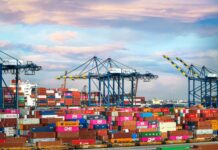
EMC has also ordered eight bridge cranes and nine gantry cranes from Chinese equipment maker Shanghai Zhenhua Heavy Industries, better known as ZPMC.
The cranes, costing US$106.87 million, will be installed in Panama’s Colon Container Terminal, which EMC acquired for US$268 million in November 2022 to strengthen its presence in the Americas.
The capital expenditure was announced together with EMC’s results for the nine months ended 30 September. In 9M 2025, EMC’s revenue was TW$293.38 billion (US$9.63 billion), 16% lower than in the year-ago period, reflecting the steep fall in container freight rates after front-loading ahead of the US implementation of tariffs on imports and hefty port fees on Chinese-built and operated ships.
Net profit fell 65%, to TW$22.08 billion (US$724.7 million).
Following a meeting between US President Donald Trump and Chinese President Xi Jinping in Busan on 30 October, both sides agreed to pause their protectionistic tactics against each other, including the lifting of US port fees for Chinese-built ships.