
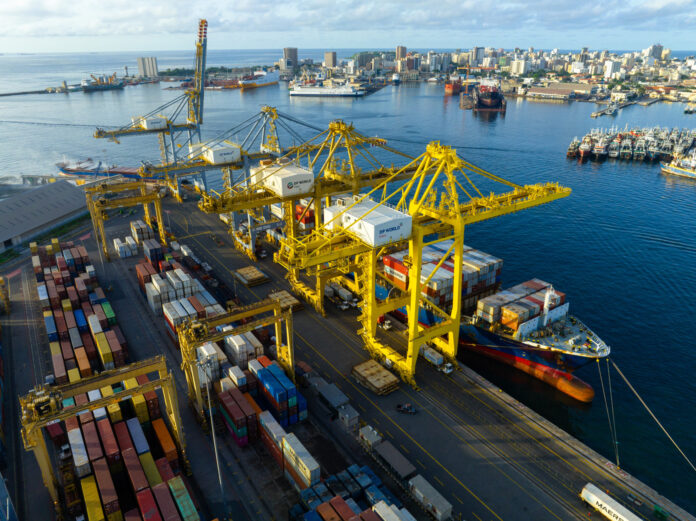
DP World has handled its 10 millionth container at the Dakar Container Terminal, marking a significant operational milestone since the company assumed management of the facility in 2008.
The achievement reflects a sustained transformation of the terminal over nearly two decades of investment and operational development.
Since taking over in 2008, DP World has invested approximately US$ 340 million in the terminal’s modernisation and capacity expansion. Annual throughput has grown from 265,000 TEUs in 2008 to 850,000 TEUs in 2025, while vessel waiting times have been reduced from 35 hours to near zero.
The terminal is now ranked as the most efficient port in Sub-Saharan Africa according to the World Bank’s Container Port Performance Index.
The facility serves as a critical logistics gateway for Senegal and neighbouring landlocked economies, supporting trade flows across West Africa.
Among its more tangible regional contributions, the terminal provides market access for agricultural exporters, including thousands of cashew farmers in Casamance and Guinea-Bissau who rely on the Dakar gateway to reach buyers in Asia.
The terminal employs approximately 730 people, 99% of whom are Senegalese nationals, whose capabilities now extend to the remote operation of advanced equipment from a dedicated on-site control room.
Mohammed Akoojee, CEO and Managing Director for Africa at DP World, described Dakar as a benchmark for efficiency and reliability in the region, crediting sustained investment, operational expertise and local partnerships as the foundations of the terminal’s transformation.
Clarence Rodrigues, CEO of DP World Dakar, highlighted talent development as a central element of the terminal’s progress alongside technological advancement.
Looking ahead, Senegal’s maritime sector is entering a new phase with the construction of the Port of Ndayane, being developed by DP World in partnership with British International Investment approximately 50 kilometres from Dakar.
The new port is designed to provide future capacity expansion and more efficient inland logistics connectivity, addressing the physical and urban constraints of the existing terminal. Construction is progressing on schedule.