
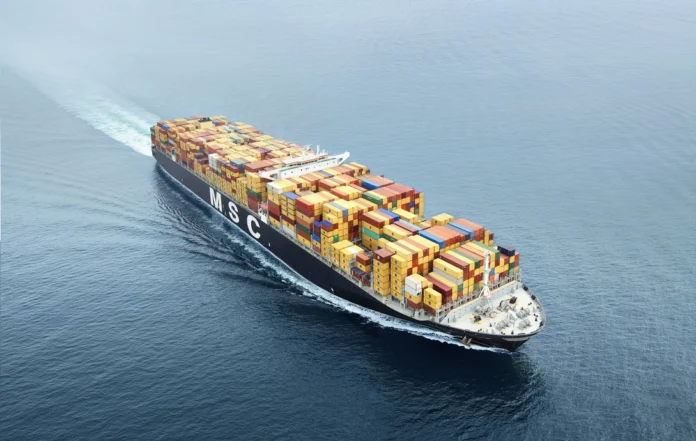
DNV has awarded an Approval in Principle (AiP) to Zhoushan Changhong International and CIMC ORIC for a new 21,700 TEU multi-fuel ready ultra-large container ship design developed in partnership with MSC, marking a further step toward next-generation, low- and zero-carbon mainline container shipping.
The AiP confirms that the concept design complies with relevant DNV class rules and international standards and provides a foundation for detailed engineering and potential commercial construction under DNV classification.
The proposed design allows shipowners flexibility in selecting alternative fuels, accommodating different propulsion technologies within a single platform. In addition to LNG dual-fuel engines, the design is prepared for the integration of next-generation ammonia-fueled main engines, enabling future fuel transitions as technologies and regulations evolve.
One of the key technical challenges addressed during the design process was fuel storage. As there is currently no combined solution capable of storing both LNG and ammonia in the required volumes, the partners developed an oversized, specialized Type C tank for ammonia, positioned alongside conventional Type B, Type C or membrane LNG tank solutions. This configuration enables safe and practical integration of multiple fuel options within the same vessel design.
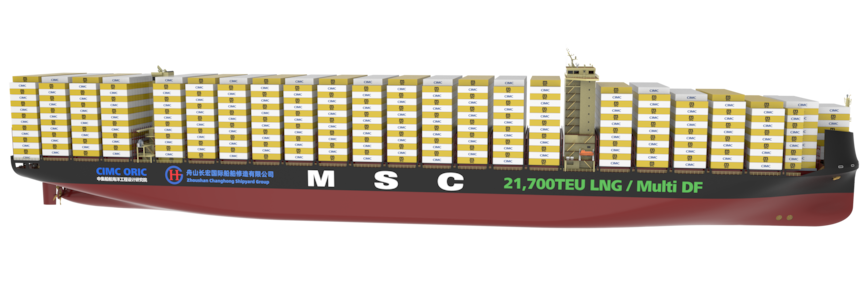
The hull form has been optimized to improve energy efficiency, featuring a new vertical bow, optimized stern and refined hull lines. These are complemented by low-resistance coatings, high-efficiency propellers and additional hydrodynamic energy-saving features. Performance has been validated through computational fluid dynamics (CFD) simulations and model testing.
“We are proud to have received an AiP for our 21,700 TEU multi-fuel container ship, with a special focus on the ammonia-fueled variant,” said Yin Xunbin, General Manager, CIMC ORIC. “This allows us to offer owners a wider range of fuel options. Our special thanks go to MSC — with their extensive expertise in LNG dual-fuel vessels, we were able to develop key design elements for the ammonia dual-fuel version. This milestone validates our commitment to providing future-ready vessels that meet global trade demands while reducing emissions.”
MSC highlighted the collaborative value of the project in supporting long-term fuel optionality. “We are pleased to support Zhoushan Changhong International and CIMC ORIC with our extensive experience in LNG dual-fuel vessels as they expand their product portfolio to include a broader range of alternative fuels,” said Giuseppe Gargiulo, Head of Newbuildings, MSC. “Although LNG remains the most proven fuel for MSC to operate container ships at this time, the insights gained from this joint project will help drive innovation for future efficient dual-fuel container ships and keep MSC open to emerging technologies.”
DNV said its classification experts reviewed the concept across key technical areas, including fuel storage and handling systems, propulsion arrangements, and safety and mitigation measures for both LNG and ammonia.
The AiP is intended to support further development toward detailed design and potential construction of ultra-large container vessels capable of meeting increasingly stringent environmental requirements.