
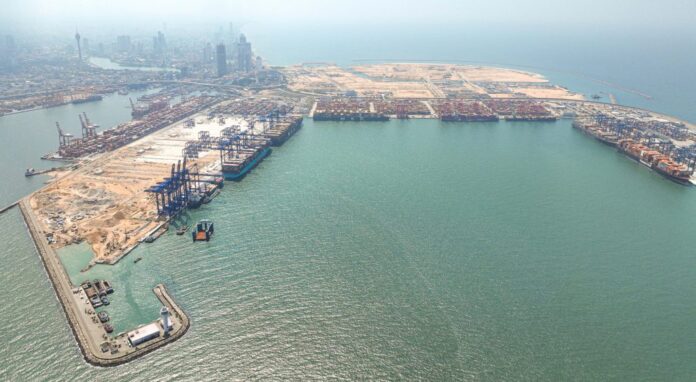
The Colombo East Container Terminal commissioned its third berth at the Port of Colombo. The Sri Lanka Ports Authority marked the operational milestone with senior representatives from Maersk, CMA CGM, and MSC attending the event.
The global carriers expressed satisfaction with recent advances in berth productivity, yard management, and vessel turnaround times. They reaffirmed their intent to deepen cooperation with the Authority-managed terminal alongside privately operated facilities. The shipping lines aim to further refine port-wide performance metrics.
Terminal Processed 500,000 TEU Despite Incomplete Infrastructure
Admiral Sirimevan Ranasinghe (Retired), Chairman of the Sri Lanka Ports Authority, conveyed appreciation to the shipping lines for their continued engagement. He noted the Colombo East Container Terminal processed over 500,000 TEU during 2025. The terminal operated with incomplete infrastructure for part of the year.
The third berth will accelerate throughput volumes materially. Ranasinghe stated the expansion strengthens Colombo’s standing as a principal transhipment center. The port serves the Indian subcontinent, the Bay of Bengal, and East-West mainline services.
Full Completion Scheduled for Mid-February
Managing Director Eng. Ganaka Hemachandra described the commissioning as a significant collective achievement. Jetty construction works will reach full completion by mid-February this year. All operational systems will integrate to enable the terminal to function at full scale.
The facility will pursue an ambitious throughput objective of 1.5 million TEU within the year. Hemachandra observed the steady advancement of the Sri Lanka Ports Authority contributes tangible economic value. The port generates foreign exchange earnings, employment, and enhanced trade connectivity.
1,300-Meter Quay Adds Deep-Water Capability
The Colombo East Container Terminal extends over approximately 1,300 meters. The facility adds substantial quay length and deep-water capability to the Port of Colombo. The terminal can accommodate large mainline vessels with minimal tidal constraints.
Colombo ranks among South Asia’s foremost container ports. The port benefits from proximity to major east-west shipping lanes. Modern handling equipment and a diversified mix of public and private terminals operate under a unified port framework.
The third berth will ease congestion and distribute vessel calls more efficiently across terminals. The addition reinforces Colombo’s reputation for dependable, high-volume container handling.
Hemachandra commended the commitment of the SLPA workforce. He acknowledged the cooperative ethos of other terminal operators within the port. Such shared responsibility remains essential to sustaining Colombo’s competitive edge in regional and global trade.