
China has announced major military drills around Taiwan, increasing pressure on the island.
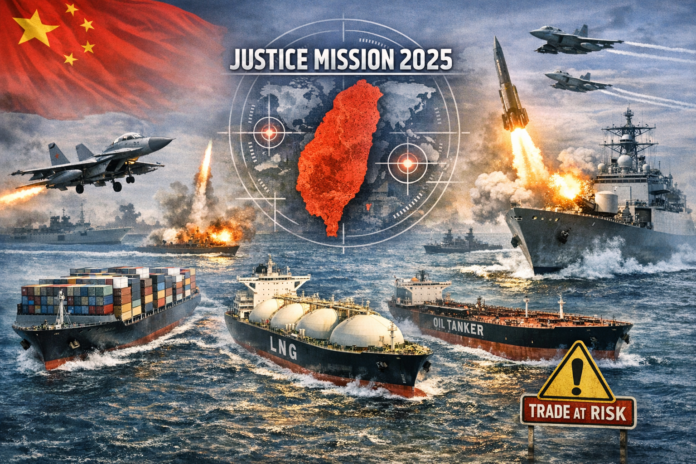
The People’s Liberation Army Eastern Theater Command said it has deployed Army, Navy, Air Force, and Rocket Force units to areas surrounding Taiwan. The exercises are code-named Justice Mission 2025 and mark the first such drills since April.
The command said the drills aim to warn what it described as “Taiwan independence” forces and external actors. It added that live-fire exercises will take place in waters and airspace around Taiwan from 8 a.m. to 6 p.m. on Tuesday.
Beijing has stepped up military activity since Taiwan President Lai Ching-te took office. China views his Democratic Progressive Party administration as pro-independence.
China also lodged a protest over comments made by Japanese Prime Minister Takaichi Sanae in Japan’s parliament regarding a potential Taiwan emergency.
Moreover, Taiwanese authorities said they are closely monitoring the situation. A presidential office spokesperson described the drills as a challenge to international law and regional order. The office said Taiwan’s military detected the movements in advance and remains fully alert.
Taiwan’s defense ministry confirmed it has activated an emergency response center. Officials said the armed forces are prepared to defend the island’s sovereignty. Authorities added that daily life remains normal and urged the public not to be alarmed.
Meanwhile, the PLA Eastern Theater Command released video footage it said showed the drills. The clips included night-time vehicle movements, a fighter jet takeoff, and naval shelling. The command did not disclose the exact locations or timing.
Lastly, Chinese state media reported that a naval fleet conducted live-fire drills around Taiwan at around 9:30 a.m. on Monday.
China’s Justice Mission 2025 drills raise geopolitical risk across regional maritime trade but do not constitute a disruption event unless they escalate in duration, scope, or unpredictability. For now, global trade absorbs the risk through higher costs and volatility, not reduced volumes.