
For decades, the Caspian Sea has been a rare calm in Eurasia’s turbulent geopolitical waters.
Enclosed by Russia, Azerbaijan, Iran, Kazakhstan, and Turkmenistan, its shipping lanes have moved oil, grain, and manufactured goods without the kind of naval friction seen in the Black Sea or the Red Sea. That stability may be under threat.
Tensions between Azerbaijan and Russia over a little-known maritime dispute are rising at a time when the region is already feeling the knock-on effects of the war in Ukraine. Even a minor incident perhaps triggered by further Ukrainian strikes on Russian assets could have outsized consequences.
The Caspian is the maritime heart of the International North–South Transport Corridor, a strategic link between Russia and Iran that bypasses Western sanctions chokepoints.
It also serves as a vital oil highway: Kazakh crude moves from Aktau to Baku before feeding into the Baku–Tbilisi–Ceyhan pipeline to the Mediterranean, while the Caspian Pipeline Consortium channels Kazakh volumes to Novorossiysk on the Black Sea.
A sustained dispute could hit all three of these arteries. Scenario modelling by maritime risk analysts shows three broad pathways. In a low-level “friction” phase, traders could face modest delays from extra patrols and inspections, pushing up transit times by 10 to 20 percent.
Moderate escalation marked by vessel detentions or disputed survey zones could slash INSTC sea capacity by up to 30 percent and delay nearly half of all Aktau–Baku tanker crossings.
At the extreme, a prolonged confrontation could render the Caspian’s north–south sea leg largely inoperative, forcing freight onto slower and costlier rail and road corridors through the Caucasus and Iran.
Energy flows are particularly exposed. Offshore Azeri and Kazakh production, including from the giant Azeri–Chirag–Gunashli and Kashagan fields, depends on a steady stream of service and supply vessels.
Heightened security zones, convoying requirements, or even perceived risks from drones and unmanned surface vehicles could force operators to postpone maintenance or shut in production. Losses of 10 to 20 percent of quarterly output are conceivable in a high-tension scenario.
The commercial impact would not stop at the Caspian’s shores. Reduced Kazakh exports could tighten supply of niche crude blends like CPC and Azeri Light, shifting pricing dynamics in European markets.
Insurance underwriters, so far quiet on the Caspian, could move quickly to reclassify it as a “heightened risk” zone, adding war-risk premiums that price out smaller shippers.
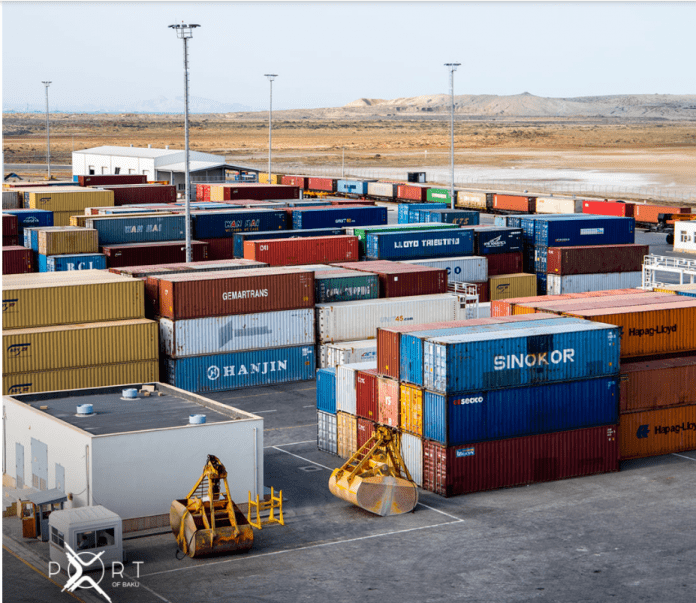
Ports and terminals from Baku to Turkmenbashi could see operations compressed into narrow safe windows, creating arrival waves and berthing bottlenecks.
Iran’s northern ports might gain temporary traffic, but would struggle to replace the capacity of the main Azerbaijan–Kazakhstan sea bridge.
What makes the Caspian scenario especially significant is its closed geography. Unlike the Red Sea or Black Sea, there is no alternative maritime route. Cargo either moves across the Caspian or it does not move at all. That leaves the region’s shippers, energy producers, and trading partners unusually exposed to any disruption no matter how small its spark.
If tensions between Baku and Moscow continue to climb, the Caspian Sea may soon join the list of the world’s maritime flashpoints, adding another layer of complexity to already strained global shipping networks.