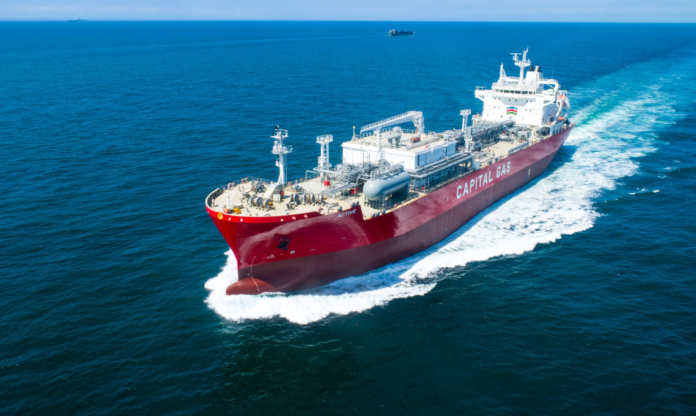
Capital Clean Energy Carriers Corp. (CCEC) has taken delivery of the world’s first 22,000 cubic metre low-pressure liquid CO2 carrier, Active, from Hyundai Mipo Dockyard, marking a significant milestone in the development of carbon transport shipping.
Active is the first of four 22,000 cbm LCO2/multi-gas carriers ordered by CCEC under its investment programme at Hyundai Mipo Dockyard. While purpose-built to transport liquid CO2, the vessel is also designed to compete in the conventional handy-sized semi-refrigerated gas carrier market.
The ships feature multi-cargo capability, allowing them to carry liquid CO2, LPG, ammonia, and selected petrochemicals. This flexibility enables deployment across different market cycles and trade routes, at a time when the orderbook for handy semi-refrigerated gas carriers remains relatively limited. CCEC said the design gives the vessels strong optionality as market conditions evolve.
At the same time, the new series has been engineered to support the emerging carbon capture, utilisation and storage (CCUS) value chain. As global CCUS infrastructure expands, demand for marine transportation of liquid CO2 is expected to increase.
According to data from the International Energy Agency’s CCUS projects pipeline, global CO2 capture capacity could reach around 430 million tonnes per year by 2030, while storage capacity could rise to about 670 million tonnes per year. Current global capture capacity is estimated at roughly 50 million tonnes per year.
As captured CO2 volumes grow and storage sites become more closely connected to industrial hubs, CCEC expects marine logistics to play a larger role in the value chain. The company said the combination of limited vessel supply, multi-cargo flexibility, and rising demand for CO2 transport places it in a strong first-mover position within a developing segment of the gas shipping market.
The Active recently received the Lloyd’s List Greek Shipping 2025 “Ship of the Year” award, recognising the vessel for opening a new chapter in carbon transportation and for its innovative tank technology and multi-cargo design.
Following delivery, the vessel will enter service under a six-month time charter transporting LPG for an energy trading company, with an option to extend the charter for a further six months. CCEC said the deployment highlights the commercial flexibility of the new vessel class while the CO2 transport market continues to develop.
The acquisition of Active was financed using $29.4 million in cash and a 12-year export credit agency-backed loan of $48.9 million. The loan will be repaid in 48 quarterly instalments of $0.6 million, with a balloon payment of $18.0 million due in January 2033. The company may also borrow up to an additional $7.5 million if the vessel secures longer-term employment.
Commenting on the delivery, Jerry Kalogiratos, Chief Executive Officer of CCEC, said the vessel represents a key milestone in the company’s strategy. He said the LCO2/multi-gas carrier series positions CCEC to support the emerging CO2 transport market while retaining the ability to trade in established gas segments, supporting cash flow resilience and disciplined capital allocation as the company expands its energy-transition focused fleet.