
LinkedIn posts depend heavily on early engagement. When a post starts picking up likes soon after publishing, it tends to stay visible longer and reach a wider audience. Without that initial activity, even well-written posts can struggle to gain momentum.
Because of this, many professionals choose to buy LinkedIn likes to strengthen their posts right from the start. A higher like count helps create stronger social proof and makes content more likely to attract additional interaction.
The key difference comes down to how the likes are delivered. Some services focus on speed, while others prioritize more controlled growth that fits LinkedIn’s environment.
Key Takeaways
- Buying LinkedIn likes is most effective when used to support early post visibility and momentum.
- The timing of likes matters as much as the number, early engagement tends to perform better.
- Like counts should match your typical post performance to keep engagement looking natural.
- Different post types require different approaches, not every post should be boosted the same way.
- UseViral stands out as the most consistent option for delivering likes that align with how LinkedIn posts develop.
- Likes work best when paired with strong content that already has a clear angle or purpose.
- Spreading engagement across posts can help maintain a more balanced profile appearance.
- Buying LinkedIn likes should be used strategically, not as a replacement for content quality.
Top 5 Sites to Buy LinkedIn Likes
Here are the best sites to buy LinkedIn likes right now.
- UseViral
- SidesMedia
- Growthoid
- Media Mister
- BuyCheapestFollowers
1. UseViral
Score: 9.9/10
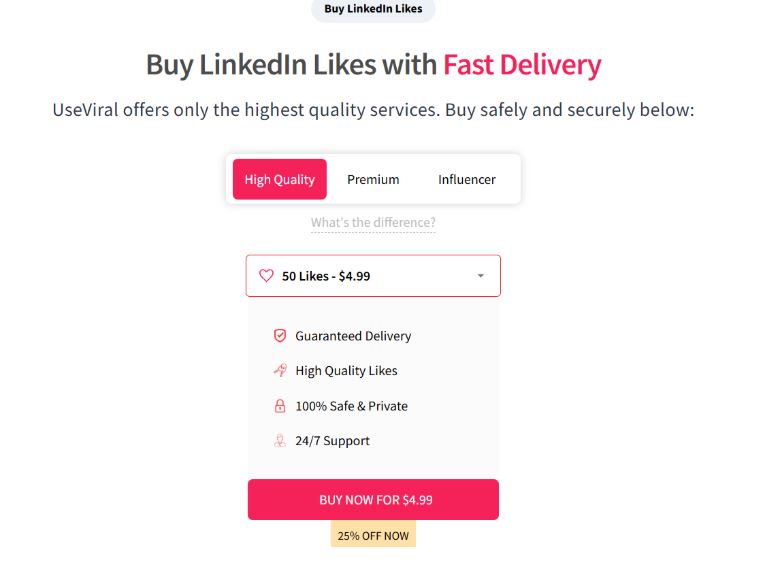
UseViral stands out mainly because of how its LinkedIn likes are structured. Instead of one generic package, you’re choosing between three tiers: High Quality, Premium, and Influencer. That difference actually matters depending on the type of post you’re trying to support.
From testing, the High Quality tier works best for standard posts where you just want to avoid low engagement. It gives you a clean baseline without overdoing it. The Premium tier is where things start to look more polished, especially on posts that need to hold credibility over time.
The Influencer tier is the strongest option and makes more sense for high-visibility posts like announcements, hiring updates, or personal brand content where perception matters more.
Another thing that stands out is how the packages are structured. You can start small (around 50 likes) or scale up to 1,000, which makes it easier to match the number to your current profile size instead of forcing a large jump.
There’s also a refill window built in, which helps keep the numbers stable if anything drops. Combined with the fact that you only need to provide the post URL, the whole process feels straightforward and low-risk.
Overall, this is the kind of setup that works better if you care about how the engagement looks, not just how fast it appears.
| Pros | Cons |
| Three distinct tiers for different post types | Higher tiers increase cost quickly |
| Easy to match like count to your profile size | Not focused on instant, aggressive boosts |
| Built-in refill coverage for stability | Larger orders need to be used carefully |
| Works well for both small and high-visibility posts | |
| Simple setup with no account access required |
2. SidesMedia
Score: 9.3/10
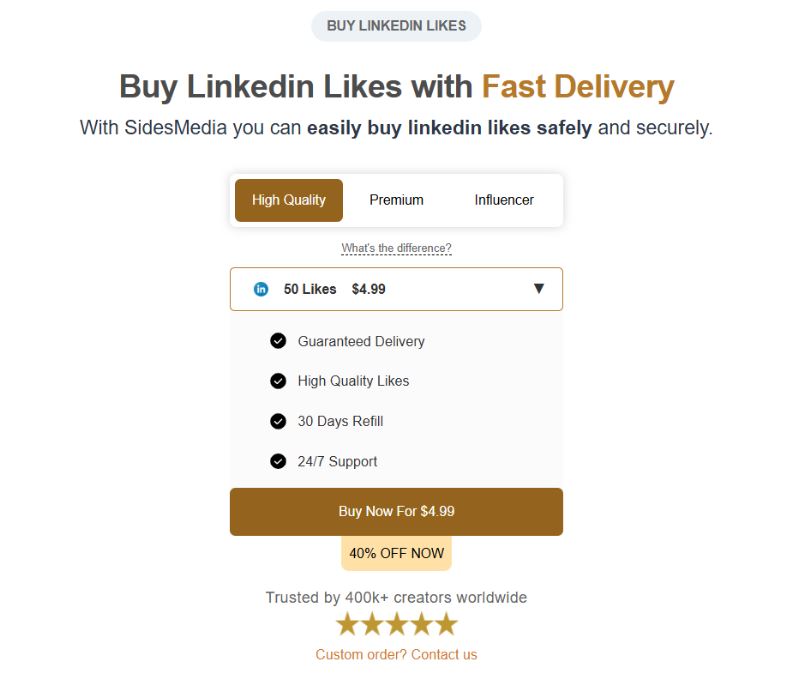
SidesMedia is built more around timing advantage than structure. When we tested it, the main difference was how quickly engagement starts showing up after placing an order. That makes it useful for posts where the first impression happens fast, especially when your content is already getting some traction and just needs a push.
Unlike tier-heavy platforms, SidesMedia keeps things more direct. You’re not choosing between multiple quality levels. Instead, the focus is on getting likes moving early and letting the post build from there.
This works well for content that relies on quick visibility, such as opinion posts, short-form insights, or anything designed to spark immediate interaction.
One thing to keep in mind is that this approach works best when the post already has some momentum. If you apply it to a post with zero activity, the increase can feel slightly disconnected. But when used correctly, it helps reinforce engagement rather than trying to create it from nothing.
| Pros | Cons |
| Engagement starts quickly, useful for early traction | Less control compared to tier-based services |
| Works well for time-sensitive or fast-moving posts | Not ideal for long-term pacing strategies |
| Simple setup without multiple package layers | Can feel too fast on low-activity posts |
| Good for reinforcing existing engagement | Limited customization options |
| Reliable for short-term visibility pushes | Not designed for highly strategic campaigns |
3. Growthoid
Score: 9.2/10
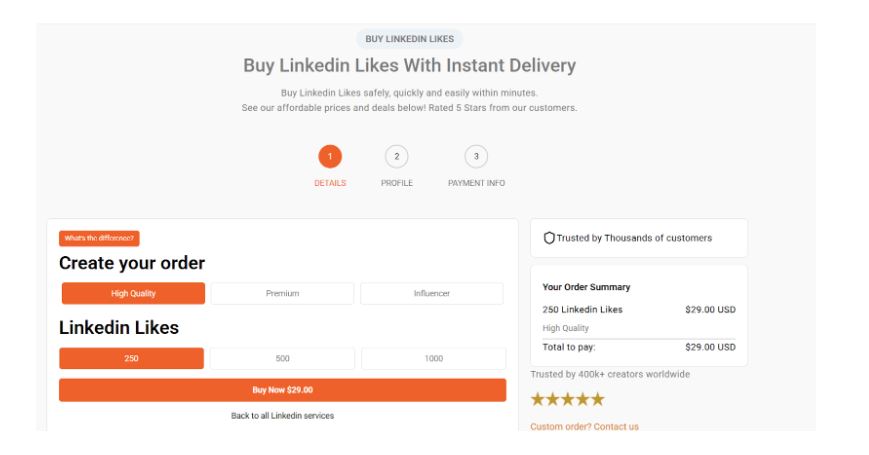
Growthoid takes a more controlled approach compared to faster providers. Instead of focusing on quick bursts of likes, it leans toward spreading engagement over a longer window, which can help posts stay active beyond the initial push.
From testing, this works better on posts that are meant to build authority rather than go viral quickly. Think longer-form content, professional insights, or posts where you expect engagement to build gradually.
Another difference is how the service fits into a broader content strategy. If you’re posting regularly, Growthoid’s pacing makes it easier to maintain a steady level of engagement across multiple posts instead of concentrating everything on one.
It’s not the best choice if you’re trying to boost a post immediately after publishing. But if the goal is to keep your content active and visible over time, the slower delivery works in your favor.
| Pros | Cons |
| Extended delivery helps maintain post activity longer | Not suitable for immediate engagement needs |
| Fits well with authority and long-form posts | Slower results compared to faster providers |
| Supports consistent engagement across multiple posts | Less impact in the first hour after posting |
| Works well with regular posting schedules | Limited value for short-lived content |
| More controlled growth pattern | Not designed for quick visibility spikes |
4. Media Mister
Score: 8.8/10
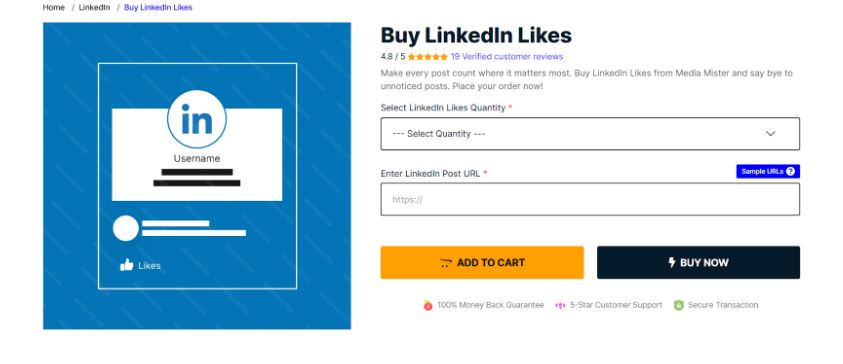
Media Mister is more structured than some of the other providers, and you notice that right away when placing an order. Instead of a quick one-click setup, you’re given more control over how the likes are delivered, including options around speed and order configuration. That makes it more suitable for users who want to fine-tune how engagement appears on a post.
From testing, this works best when you’re planning ahead rather than reacting. If you already know which posts you want to support and how aggressively you want them to perform, the added control becomes useful. You can avoid overloading a post and instead match the like count more precisely to your audience size.
The tradeoff is that it’s not as fast or as simple as other platforms. There are more steps involved, and it takes a bit more effort to configure properly. But if you want more control over how your engagement is delivered, it gives you that flexibility.
| Pros | Cons |
| Greater control over delivery settings | More complex setup compared to others |
| Easier to match likes with audience size | Slower to configure and launch |
| Works well for planned content campaigns | Not ideal for quick boosts |
| Suitable for business and company pages | Requires more effort to use effectively |
| Can be combined with broader engagement strategy | Less beginner-friendly |
5. BuyCheapestFollowers
Score: 8.7/10
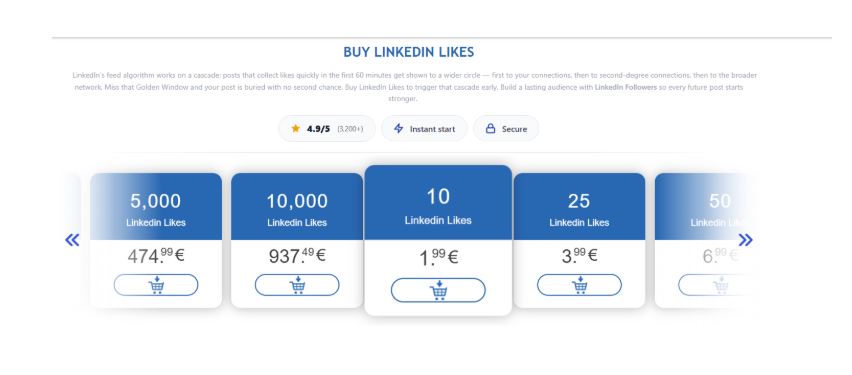
BuyCheapestFollowers is positioned more toward cost efficiency, which becomes obvious once you start comparing package sizes and pricing. It’s one of the easier options to use if your goal is to test how LinkedIn likes affect your posts without committing to higher-tier services.
From testing, this works best in controlled scenarios where you’re experimenting rather than pushing high-stakes content.
For example, if you’re trying different post formats or adjusting your posting frequency, smaller like packages can help you understand how engagement changes without overinvesting.
Another thing worth noting is how straightforward the setup is. There are fewer decisions to make compared to more structured platforms, which makes it quicker to execute when you need a simple boost. That simplicity can be useful if you’re running multiple tests across different posts.
However, this also means there’s less refinement in how the engagement is delivered. You’re trading precision for accessibility, which is fine for lower-priority content but less suitable for posts where presentation and consistency matter more.
| Pros | Cons |
| Lower pricing makes it accessible for testing | Less refined delivery compared to premium services |
| Quick setup with minimal configuration | Limited control over how likes are distributed |
| Useful for experimenting with different post types | Not ideal for important or high-visibility posts |
| Works well for small, low-risk campaigns | Engagement can feel less consistent |
| Good entry point before scaling up | Fewer advanced options available |
Do LinkedIn Likes Actually Improve Post Performance?
Likes on LinkedIn act as an early signal that a post is worth paying attention to. When a post starts picking up engagement soon after it goes live, it tends to stay in circulation longer and reach more people through the feed.
In practice, the impact depends on how the likes are used. Posts that already have a clear angle: career updates, strong opinions, or industry insights – benefit the most because the added engagement reinforces something that’s already working. It helps the post gain traction faster and makes it more likely to attract additional interaction.
On the other hand, likes alone won’t carry a weak post. If there’s no reason for people to engage, the effect is limited. The real advantage comes when the likes support content that is already positioned to perform.
So while buying LinkedIn likes can improve post performance, it works best when it’s applied to the right type of content and at the right moment, not as a standalone fix.
How to Choose the Right LinkedIn Likes Service
Choosing a LinkedIn likes service is less about the provider itself and more about how it fits the post you’re trying to support. The same number of likes can either strengthen a post or make it look off, depending on how it’s used.
Start with the type of content. A hiring post, for example, usually performs better with steady engagement that builds over time. A short insight or opinion post benefits more from a faster push, since those rely on immediate visibility. Matching the delivery style to the post type makes a noticeable difference in how natural the engagement looks.
Next is timing. Some services are better suited for use right after publishing, while others work better when applied slightly later to keep the post active. If you apply likes too early or too late without considering the post’s activity, the result can feel disconnected.
It also helps to think in proportions. The number of likes should make sense compared to your typical post performance. Large jumps on a low-activity profile tend to stand out, while smaller, consistent increases blend in more easily.
Comparison Overview
| Platform | Best For | Delivery Style | Good Fit For | Main Tradeoff |
| UseViral | Long-term post support | Gradual, structured | Authority posts, announcements | Slower start on big orders |
| SidesMedia | Immediate traction | Fast, front-loaded | Time-sensitive posts | Less control |
| Growthoid | Extended activity | Slow, spread out | Consistent posting strategy | Delayed impact |
| Media Mister | Controlled campaigns | Configurable | Planned content rollout | More setup required |
| BuyCheapestFollowers | Testing engagement | Fast, basic | Low-priority posts | Less refinement |
In the end, the right choice depends on how you want your post to perform, not just how many likes you want to add.
Conclusion
If you’re planning to buy LinkedIn likes, the key is using a service that aligns with how your posts are meant to perform. The right approach can strengthen visibility, support engagement, and improve how your content is perceived.
UseViral stands out as the most consistent option, especially when you want likes that build in a way that fits naturally with your post over time. That kind of delivery tends to support both reach and credibility without making the engagement feel forced.
When used properly, buying LinkedIn likes can help your content gain momentum and perform more effectively.
Frequently Asked Questions
Do LinkedIn likes help posts reach people outside your network?
Yes, they can. When a post gains early engagement, it’s more likely to appear in second- and third-degree networks. That’s where most additional reach comes from on LinkedIn.
When is the best time to add likes to a LinkedIn post?
Timing depends on the post. For short-form or opinion posts, adding likes early can help push visibility. For longer or authority-style posts, spacing them out tends to look more natural.
Should every LinkedIn post have the same number of likes?
No. Your like count should vary based on the type of content. Consistent numbers across every post can look unnatural, while variation helps your profile appear more realistic.
Can buying likes affect how people interact with your content?
It can influence perception. Posts with visible engagement are more likely to attract additional interaction, especially from people who are already viewing your content.
Is it better to spread likes across multiple posts or focus on one?
That depends on your goal. Spreading likes helps maintain a consistent profile appearance, while focusing on one post is more effective if you’re trying to push a specific message or update.
Do LinkedIn likes work differently for personal profiles and company pages?
Yes. Personal profiles tend to gain traction faster with engagement, while company pages usually require more consistent activity to see similar results.