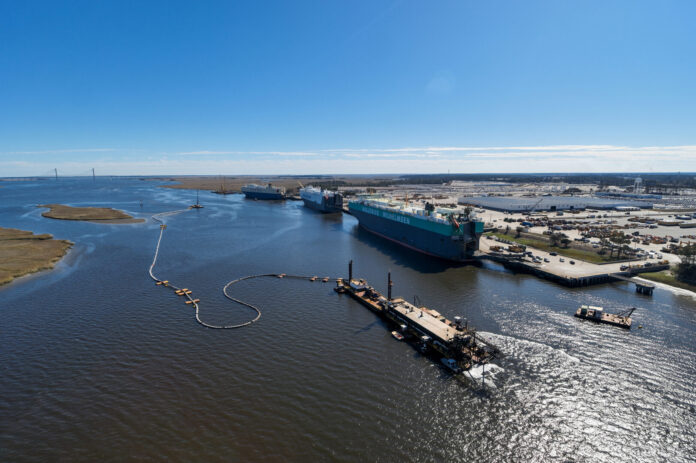
Maintenance dredging is underway in the inner and outer harbor of the Port of Brunswick, with operations targeting the restoration of the channel to its federally authorised depth.
The work, funded by the federal government and carried out by the US Army Corps of Engineers, addresses shoaling and other natural sediment accumulation processes common to harbor environments.
Current operations are expected to conclude in March, with a further phase of work scheduled for the summer.
The dredging is of particular significance for Brunswick’s role as the leading automobile port in the United States.
Restored channel depth allows roll-on/roll-off vessels to transit with greater safety and efficiency, and critically enables ships carrying heavier cargo loads to navigate the channel without waiting for high tide.
Bruce Fendig, President of the Brunswick Bar Pilots Association, highlighted both benefits as directly relevant to the operational demands placed on the port.
The maintenance work coincides with a broader expansion of port infrastructure. Construction is underway on a fourth berth for RoRo cargo at Colonels Island, representing an investment of US$ 100 million and expected to be completed in autumn 2027.
A separate harbor improvement project led by the Corps of Engineers is also planned for later this year, encompassing a bend widener and an expanded turning basin to facilitate vessel manoeuvring.
Congress has approved USD 11.35 million in federal funding for this project, with Georgia Governor Brian Kemp and the state legislature allocating just over USD 6 million to cover the state’s share.
Griff Lynch, President and CEO of Georgia Ports, described the deeper water as directly beneficial to customers serving the fast-growing Southeast market.
Colonel Ronald Sturgeon, Commander of the Savannah District for the Corps of Engineers, framed the combined programme of dredging and infrastructure investment as a commitment to safe, efficient and environmentally responsible waterway management supporting economic growth across Georgia and the broader national economy.
The growing scale of RoRo newbuilds lends additional urgency to the harbour improvements.
Vessels with capacities between 4,000 and 8,000 car equivalent units now represent the most common newbuild size, with ships of up to 10,000 CEUs expected to enter East Coast service in the future.