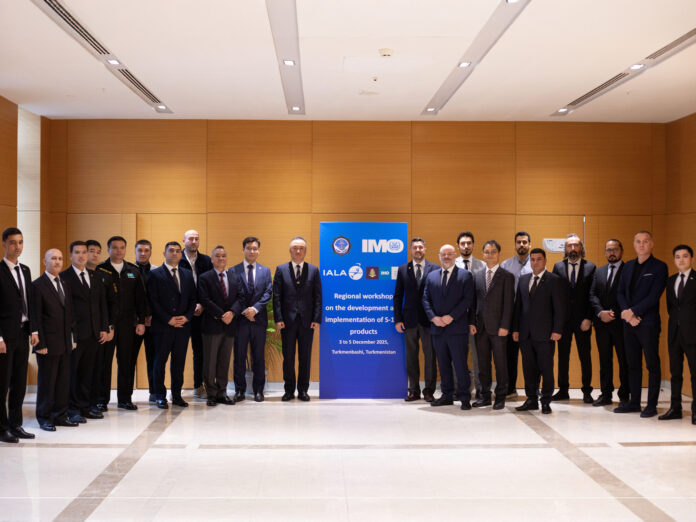
Maritime officials from Black and Caspian Sea states completed their first regional workshop on S-100 products. The event took place in Turkmenbashi, Turkmenistan, from 3 to 5 December.
The International Maritime Organization (IMO) co-organized the workshop. It worked with the International Hydrographic Organization (IHO) and the International Organization for Marine Aids to Navigation (IALA). The partners aimed to raise awareness about S-100 and its implementation.
S-100 is a modern standard for digital maritime data. It improves how ships access navigational information and works through systems such as ECDIS (Electronic Chart Display and Information System). Also, it supports e-navigation by integrating data such as water depth, tides, currents, and weather into one system.
This digital model helps ships operate more safely. It improves decision-making on board. It also increases situational awareness.
S-100 is a key part of the IMO’s e-navigation strategy. It will soon become mandatory. The IMO adopted new ECDIS performance standards in 2022 at MSC 106. The IMO updated them again in 2024 at MSC 108. These changes require all ECDIS systems installed on or after 1 January 2029 to use S-100.
Eighteen government officials attended the workshop. They came from Azerbaijan, Georgia, Kazakhstan, Türkiye, and Turkmenistan.
The participants shared updates on national services. These included hydrographic, navigational, and meteorological functions. They also discussed how to bridge the gap between current systems and future requirements.
Officials reviewed how to develop S-100 data services. They focused on production, distribution, and data management. They also examined electronic navigational data services, known as ENDS.
The workshop also covered real-time services. These included navigational warnings, weather updates, and route exchange. Participants learned how data must work together inside ECDIS.
The event strengthened regional cooperation. It also laid the foundation for shared implementation. The countries now move closer to adopting S-100 across the Black and Caspian Seas.