
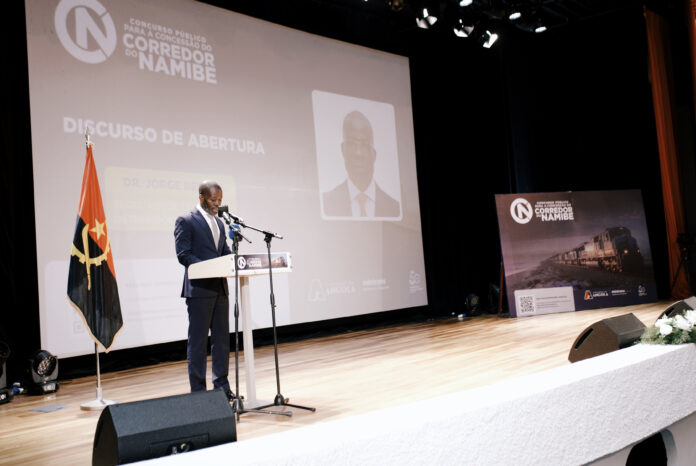
The Ministry of Transport of the Republic of Angola has launched an international public tender for the concession of the Namibe Corridor. The announcement was made on December 5, 2025. Interested parties may submit bids until May 4, 2026.
The concession will run for 30 years, with the option to extend it to 50 years.
It covers the operation, management, maintenance, and preservation of the Moçâmedes–Menongue railway line. The contract also includes rolling stock, infrastructure, workshops, and a training center. In addition, the concession allows for the design and construction of new sections, extensions, and branch lines. The operator may also develop rail links to Namibia and, later, to Zambia.
During the launch event, Secretary of State for Land Transport Jorge Bengue said the project offers major opportunities for global rail operators. He stated that the Namibe Corridor could strengthen Angola’s position as a logistics hub, improve supply chains, attract new investment, and increase export competitiveness. He added that the government expects strong interest from established international operators.

Bengue also highlighted Angola’s recent reforms, which he said have improved legal certainty and business conditions. He pointed to the successful concession of the Lobito Corridor as evidence that Angola can deliver effective public-private partnerships and modernise transport infrastructure.
Both individual companies and consortiums may apply. Applicants must show proven experience in managing rail infrastructure and freight operations. The government has set the price of the tender documents at USD 20,000, payable in U.S. dollars or in kwanzas at the official exchange rate set by the National Bank of Angola.
The Namibe Corridor includes the 855-kilometre Moçâmedes Railway and the Port of Namibe. Together, they form a key logistics route for exporting minerals, agricultural products, ornamental stone, and other goods. The corridor has a theoretical capacity of up to 5 million tonnes per year and provides access for landlocked countries through connections with the Lobito and Walvis Bay corridors.
The project is also expected to support tourism and regional integration. It will strengthen Angola’s role in Atlantic–Indian trade routes and reinforce its position as a commercial hub in Africa.